Managing Editor’s Note: Remember to sign up to join Jeff Brown TODAY at 2 p.m. ET for his special event.
We’re closing in on March 16… when Jeff believes Nvidia is about to shake up the market. It’ll send some popular tech stocks spiraling and others soaring.
There’s still time to go here to automatically add your name to the list… and if you add your phone number to sign up for VIP access, you can collect a special report that spotlights one company Jeff believes is safe from the culling – Jeff’s Bulletproof AI Pick. You’ll also receive alerts to ensure you don’t miss a thing…
The chaos in the Middle East is sending oil and stock prices soaring and plunging… all in the same trading session.
Reports of intensifying missile strikes are emerging right alongside headlines that the hostilities could be near an end. There’s even confusion around the Strait of Hormuz and whether tanker traffic is starting to flow again.
So far this week, oil prices have soared to nearly $120 per barrel before dropping to $86. The S&P 500 fell over 1% to start the week before recovering the loss.
And the turmoil doesn’t seem likely to slow down…
Just when it seems like investors have enough to contend with, another key market-moving event is about to collide with geopolitical uncertainty. The Federal Reserve is about to kick off its second meeting this year to discuss and vote on the appropriate level of interest rates.
That decision could be just as consequential for investors and the stock market as the developments in the Middle East.
The Fed could be facing its worst crisis in over 40 years. So today, let’s break down the Fed’s dilemma… and the steps you can take to prepare your portfolio.
I warned you six months ago that the Fed could soon face a dual threat to inflation and the labor market.
The dreaded “stagflation” scenario is now on our doorstep, especially following the events in the Middle East.
Commodities rallies put upward pressure on inflation. The Fed’s own research suggests that every $10 per barrel rise in oil adds 0.2% to inflation.
And it’s not just oil prices. Oil flows through to things like gas prices and jet fuel. The Middle East is also a key producer of ingredients for farm fertilizers, which could impact food prices.
At the same time, conditions in the labor market appear to be getting worse. The most recent payroll report for February showed a loss of 92,000 jobs versus estimates for a gain of 50,000.
That continues a trend of stalling job creation since the start of 2025. Take a look at the chart below, which tracks monthly job creation:
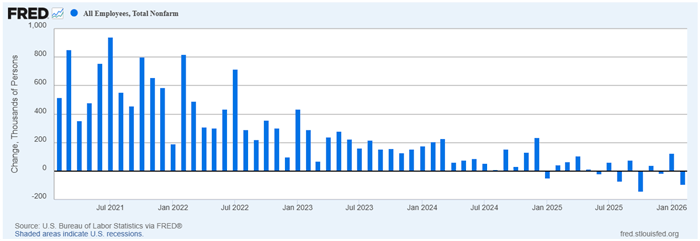
A worsening labor market coupled with rising inflation is a rare event. After all, inflation is often high when unemployment is low. That points to a strong economy. Meanwhile, inflation is usually low and falling when unemployment is high or when the economy is weak.
The Fed faces a dilemma. Either it will be forced to fight inflation and risk making the economy worse. Or the central bank can keep policy loose to support the economy… but let inflation get out of control.
The last time the Fed encountered this type of situation, volatility across major asset classes surged higher.
We’re already seeing a return of volatility across numerous markets. But if the stagflation scenario worsens, history suggests there is more to come…
The last time the economy faced a severe stagflation scenario was during the 1970s. Perhaps it’s no coincidence that conflict with the Middle East played a pivotal role back then as well.
Monetary policy went haywire, with the Fed cutting rates as low as 3.3%… and then pushing them as high as 19%.
That drove incredible whipsaws across numerous markets.
During the 1970s, investors faced a lost decade, as the Dow Jones Industrial Average went nowhere from 1966 to 1982.
In between, the Dow saw four rallies of 30% or more during that stretch. Two of those bull runs topped 70% gains. The index also experienced three bear markets, with the worst instance dropping 46%.
Precious metals look like a safe place to hide… until you realize that gold is subject to large price swings as well. While gold is remembered for soaring during the 1970s, it also suffered a 48% loss in the middle of the uptrend.
And forget about bonds if inflation takes off. During the same time frame, the Dow went nowhere, the yield on the 10-year Treasury started at 4.65% and went as high as 15% (recall that bond prices fall when yields rise).
If you’re a buy-and-hold investor or saving for retirement, I can’t imagine a worse scenario than stagflation.
But for traders with the right approach, this is the type of volatility that can deliver some of the most profitable trading opportunities that you’ll ever see.
I’ve weathered my fair share of turbulent markets over my 40+ year trading career. So if you want to see how I approach trading and receive a monthly report breaking down the macro themes impacting the markets, then consider checking out One Ticker Trader. You can learn more about how to join right here.
Happy Trading,
Larry Benedict
Editor, Trading With Larry Benedict
Reading Trading With Larry Benedict will allow you to take a look into the mind of one of the market’s greatest traders. You’ll be able to recognize and take advantage of trends in the market in no time.