Managing Editor’s Note: The New York Times called the upcoming SpaceX IPO “a generational moneymaking event.” But our colleague Jeff Brown says… You should NOT buy shares of SpaceX before seeing his Elon Musk update.
In short, this coming Wednesday, June 3, at 8 p.m. ET… he will be reporting directly from SpaceX’s headquarters to show you what he believes is the single best way to cash in on this historic IPO.
Click here to automatically see the details and save your seat.
The AI-fueled boom is rivaling some of history’s biggest bubbles.
Semiconductor companies have added as much market value in a few weeks as they did in the previous year. The stock market is soaring as a result.
But enthusiasm for AI isn’t universal. Confidence among consumers is hitting the lowest level ever seen… driven in part by AI’s disruptive potential.
It all adds up to one of the greatest divergences the economy and stock market have ever seen. AI is fueling a boom in one corner of the stock market, while recession signals are triggering at the same time.
Here’s the latest evidence that stock market mania is reaching a new extreme as consumer moods align more with an economic bust…
Across my four-decade trading career, I’ve seen my fair share of stock market bubbles and manias. But this is becoming the biggest I’ve ever seen, with much of it concentrated in just one sector… semiconductors.
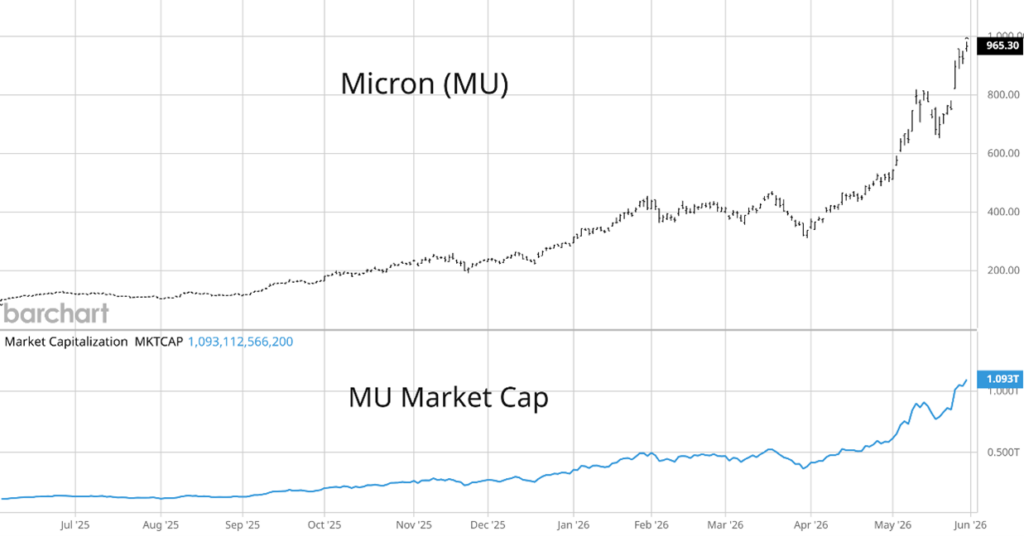
Take Micron Technologies (MU), for example. The stock has gained 90% in the last month. The company added over $500 billion in market value during that span.
The amount of market cap added over the past 30 days is nearly six times what the company was worth just a year ago. The chart below plots MU’s price along with its market cap.
Tech-sensitive economies are seeing their stock markets soar as well. The Korea Composite Stock Price Index (KOSPI) is the primary benchmark for South Korea.
The KOSPI’s heavyweights include Samsung and SK Hynix… both chip stocks that are now worth more than $1 trillion each. The index is up 101% so far this year.
Another sign of the times is the new Roundhill Memory ETF (DRAM). The fund tracks a narrow group of AI chipmakers and was just launched in April.
The fund’s assets under management hit $10 billion in just 50 days, becoming the fastest ETF to ever reach that milestone.
That shows how much investors are clamoring for the market’s hottest stocks.
But chasing stocks at these levels could be dangerous to your financial health, especially when you consider the unease spreading across the broader economy.
At a time when investor hype over AI-driven chip stocks has been intensifying, consumer moods are in the dumps.
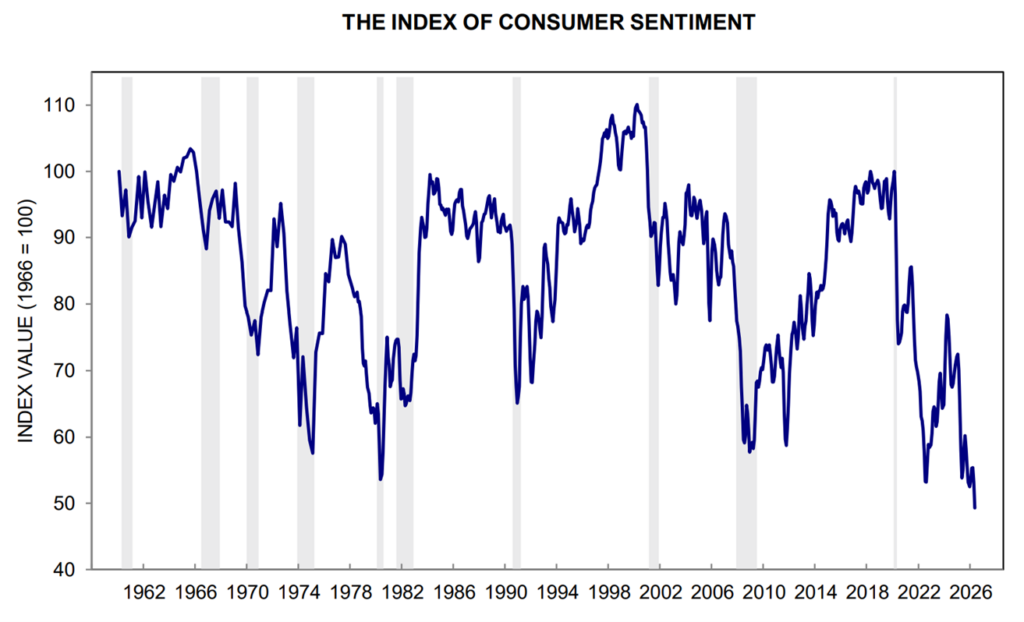
The University of Michigan has released an index of consumer sentiment since the 1950s. In the most recent report covering May, the index dropped to the lowest level ever seen in more than 70 years of data. Here’s the chart below.
Source: University of Michigan
The reading of 44.8 in May was even below the levels seen during 2008’s Great Financial Crisis. You can see in the chart that low levels of consumer confidence are usually seen during recessions, which are the shaded areas in the chart.
That makes sense because poor consumer moods impact spending, which is a major driver of the U.S. economy.
So something isn’t adding up when you compare the action in AI-driven stocks with the broader consumer gloom.
The war in the Middle East and its impact on energy prices and inflation are certainly playing a major role. But economists also point to fears about the disruptive potential of AI on the labor market.
While advances in AI applications and spreading adoption are exciting for investors, Main Street isn’t convinced. Headlines about job losses and layoffs due to AI could be one big reason for the low spirits.
A recent survey shared that as many as 99% of executive officers expect AI to lead to headcount reduction in the next two years. And the outlook appears particularly grim for entry-level workers.
Something doesn’t add up. And my fear is that the parabolic move in AI stocks will come crashing down… just like every other bubble I’ve seen.
Happy Trading,
Larry Benedict
Editor, Trading With Larry Benedict
Reading Trading With Larry Benedict will allow you to take a look into the mind of one of the market’s greatest traders. You’ll be able to recognize and take advantage of trends in the market in no time.