Larry’s Note: Today at 2 p.m. ET, I’m going to share my plan for profiting amid the market’s chaotic swings. As we’ve seen lately, the AI boom that propelled the market last year has been faltering… and as geopolitical tensions grow, stocks have started swinging back and forth in ever more dramatic fashion.
But that doesn’t mean you can’t make money in these moments… In fact, my AI Chaos to Cash event is aimed at showing you exactly how to trade successfully amid this volatility. You can enter a trade before 11 a.m. ET and have money sitting in your account by 4 p.m.
So if you’d like to learn how that’s possible, there’s a short time left to add your name to the guest list. You can RSVP with one click right here. And if you sign up as a VIP, you can get my 2026 AI forecast with two recommendations (one to buy and one to avoid)…
The Federal Reserve is facing an inflation nightmare.
Price levels are accelerating. And we haven’t even felt the impact of soaring energy prices from the conflict in the Middle East yet.
The central bank upped its forecasts for where consumer inflation will end the year. That number remains well above the Fed’s 2% inflation target. In fact, the Fed’s preferred inflation measure hasn’t been below 2% in five years.
The market is quickly repricing the outlook for rate cuts. And one key leading indicator is sending a major warning signal for the first time in years.
Stocks are already feeling the impact of all these changing calculations. Yet the volatility could just be getting started.
Let’s break down the situation and see what it means for traders…
After a long pause, the Fed resumed cutting interest rates at its meeting last September. The Fed made three consecutive reductions of 0.25% to the short-term fed funds rate.
Heading into 2026, market-implied odds projected more rate cuts this year, albeit at a slower pace.
But the inflation outlook is changing everything.
The most recent Producer Price Index (PPI) showed core producer prices reaching 3.9% in February compared to last year. (The core measure excludes food and energy prices.) This is a sharp acceleration from the core PPI’s annual rate of 3.0% just three months ago.
That’s important because PPI tends to lead changes in consumer inflation. After all, when businesses’ costs increase, they tend to pass that along by raising the prices they charge their customers.
The Fed’s preferred inflation gauge, the core Personal Consumption Expenditures (PCE) price index, is already at 3.1%. It hasn’t been below the Fed’s 2% inflation target since February 2021.
And keep in mind that no inflation report released thus far takes into account the surging energy prices across oil and gas markets. Rising costs for fuel and electricity flow into the production costs of goods and services, particularly transportation and manufacturing. That’s why energy prices can have a significant inflationary impact.
With signs that inflation already started to increase before the war in the Middle East, investors are becoming unnerved by the outlook for the Fed’s monetary policy.
And one key metric sensitive to the rate outlook just crossed an important level. That last time it happened, the S&P 500 soon plunged into a bear market…
The stock market is extremely sensitive to the outlook for interest rates. Lower rates help provide liquidity, which is a tailwind for risky assets like stocks. Lower rates also present less competition for investor capital, which helps equity prices.
Following the developments on the inflation front, the outlook for interest rates is quickly evolving. Market-implied odds show rates holding steady during the rest of the year. In fact, current odds don’t show another cut until late 2027.
But another indicator is pointing to something worse. The 2-year Treasury yield tends to lead changes in the fed funds rate.
Over the past week, the 2-year crossed above the upper target range of fed funds, which is currently at 3.75%. The 2-year now yields 3.90%.
Here’s a chart that overlays the 2-year (green line) along with the effective fed funds rate (blue line).
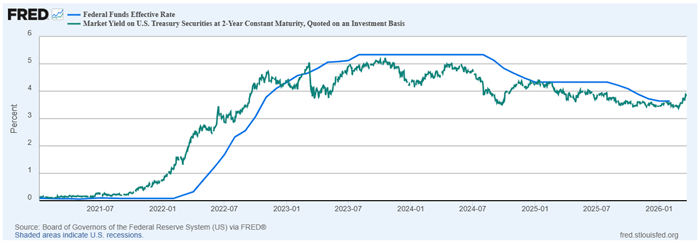
As you can see, the 2-year often leads the way for fed funds. That’s why you should pay close attention whenever the 2-year crosses above or below fed funds. It signals a major change in monetary policy.
With the recent cross above, the bond market is warning that rate hikes could be in store.
The last time the 2-year sustained a move above fed funds happened back in 2021. That happened ahead of a tightening campaign that took fed funds to the highest level in over 20 years as the Fed sought to bring inflation under control.
The S&P 500 went on to drop as much as 25% during 2022’s bear market.
There’s no telling how the S&P 500 would respond this time around. But it’s worth noting that the S&P’s sell-off accelerated at the end of February as the 2-year yield started jumping higher.
For all the headlines coming out of the Middle East, the action in the 2-year yield is becoming the most important catalyst impacting stock prices.
Happy Trading,
Larry Benedict
Editor, Trading With Larry Benedict
Reading Trading With Larry Benedict will allow you to take a look into the mind of one of the market’s greatest traders. You’ll be able to recognize and take advantage of trends in the market in no time.