Managing Editor’s Note: Our colleague Jeff Brown has been bullish on Nvidia since around 2016. But now he believes Nvidia is going to trigger a massive crash on March 16. It could send hundreds of popular tech stocks falling…
This exact type of “culling” happened during the Internet and smartphone booms. And now Jeff is pinpointing which AI stocks will be winners… or losers… in the days ahead.
Even better, he’s about to share the names of his top bullish and bearish picks… and if you want to learn what they are, you need to RSVP for Jeff’s event on Thursday, March 12 at 2 p.m. ET.
To add your name to his guest list with one click, simply go right here.
The Middle East is spiraling out of control.
Following the U.S.-led military operation against Iran (which culminated in the killing of the country’s supreme leader, Ali Khamenei), Iran responded with missile and drone attacks against targets in multiple other countries.
The conflict is dragging the entire region into chaos.
Yet while the uncertainty sparked fear among investors, the U.S. stock market has been mostly spared from a major sell-off. The first day of trading after the conflict began saw the S&P 500 finish flat.
But key moves are underway in other market sectors… and the consequences could pose a huge risk to the stock market…
The most significant impact of turmoil in the Middle East has been on energy markets. The region produces roughly 30% of the world’s oil and 17% of its natural gas.
Iran is attacking the energy infrastructure of neighboring countries and targeting key energy chokepoints.
The Strait of Hormuz is a narrow transit point situated off Iran’s southern coast. Approximately 20% of the world’s liquid petroleum products flow through the strait every day. It’s also a key route for liquified natural gas (LNG) and sees about 20% global LNG exports pass through.
Energy prices are skyrocketing as a result. Domestically, oil prices have jumped 11% since the conflict began and are up $17 per barrel since the start of the year. Brent crude is a better global benchmark for oil prices and is up $20 per barrel since December.
Rallies in other key commodities like copper have already been underway. And now broad commodity indexes are breaking above important levels.
Here’s the chart of the iShares GSCI Commodity-Indexed Trust (GSG):
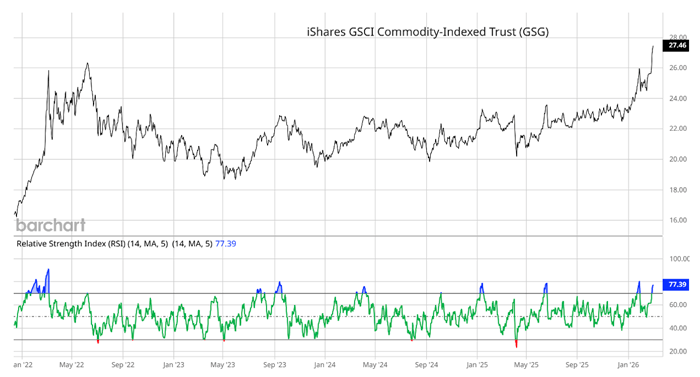
GSG is rallying above the high from 2022. Relative to the low in 2025, the index is now up 36%.
That’s important because a rally in commodity prices can drive an increase in consumer inflation. In fact, a Federal Reserve study found that every $10 per barrel rise in oil prices added 0.2% to headline consumer inflation.
The impact of rising commodity prices on inflation is a massive risk facing investors. Let’s look at why – and the key levels of inflation that matter most…
Inflation, interest rates, and stock valuations all have a connected relationship.
Inflation is a key driver of interest rates. Rising or falling inflation can help push rates higher or lower. In turn, interest rate levels impact the present value of future expected corporate profits. High levels of inflation are associated with lower stock valuations.
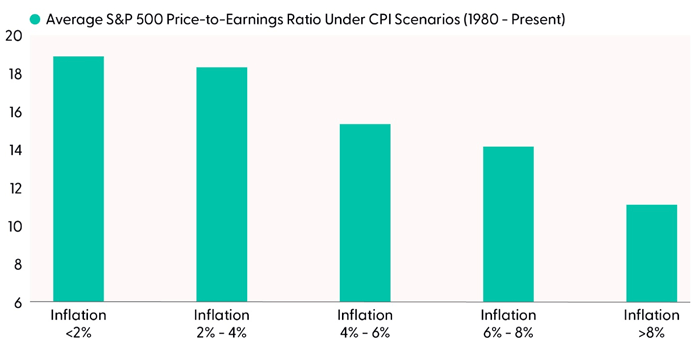
As a result, higher interest rates tend to hurt the stock market. Just take a look at the chart below. It plots the average price-to-earnings (P/E) ratio for the S&P 500 based on the level of consumer inflation.
Source: LPL Financial
You can see the sweet spot is when inflation is running below 4%. That’s when the P/E ratio averages its highest level. But as inflation starts to accelerate above 4%, valuations take a hit.
Since late 2022, a trend of “disinflation” has been in place. The Consumer Price Index (CPI) fell below 4% in mid-2023.
But consumer inflation has stalled out around the 2.5-3.0% level over the past couple of years.
And now the rally in oil prices and other commodities threatens to push inflation even higher.
The last major commodities rally peaked in 2022. That saw the CPI top out at 9%, which was a significant catalyst for the bear market that same year.
Recently, the S&P 500’s P/E ratio topped out at the highest level since the internet bubble. If valuations start to tumble, there’s a long way to fall.
So this is no time for investors to be complacent. Keep a close eye on commodity prices and their impact on inflation as this conflict progresses…
Happy Trading,
Larry Benedict
Editor, Trading With Larry Benedict
Reading Trading With Larry Benedict will allow you to take a look into the mind of one of the market’s greatest traders. You’ll be able to recognize and take advantage of trends in the market in no time.