When folks are new to trading options, they often stick with basic strategies where there’s just one component to the trade – a call or a put option.
There’s nothing wrong with that. I often use these strategies to capture a move in a stock.
However, a challenge can arise when the anticipated move is smaller than expected. Even if you get the direction right, you might not make a profit on the trade.
That’s where adding another leg to your strategy can be useful. By trading a spread, you can reduce the overall cost and put the odds more in your favor.
So let’s check out one spread strategy that can help…
The strategy I want to discuss today is a “bull call spread.” If that seems like a mouthful, just break it down into its parts – we’re bullish, it’s a spread trade, and we’re using call options.
With this strategy, you buy a call option, and you also sell a call option at a higher strike price. You need to use the same expiration date for both options and enter both legs of the trade simultaneously.
The premium you receive from selling the higher strike option partially offsets the cost of buying the lower strike option.
By selling this extra leg, you lower your breakeven. That increases the odds of the trade being a success. However, the sold call option leg puts a cap on your potential profits. So you need to consider that before placing your trade.
To see how a bull call spread works, let’s check out an example with Microsoft (MSFT). And please note that this is just an example – it’s not a trade recommendation.
Microsoft (MSFT)
Source: e-Signal
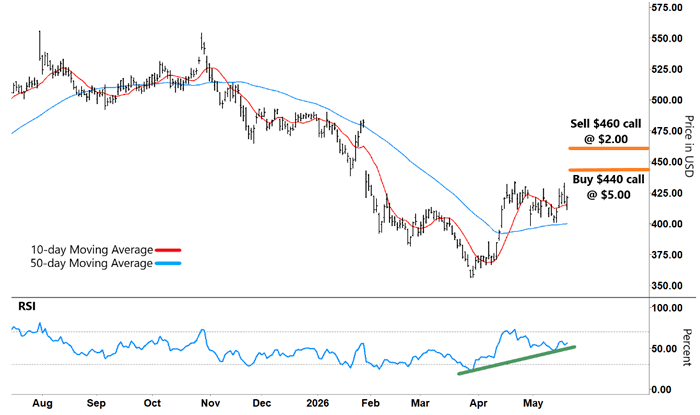
In late March, the Relative Strength Index (RSI) formed a “V” and rallied from oversold territory (lower gray dashed line). That rising momentum helped MSFT rally off its lows.
Then, after a period of consolidation, the RSI formed a higher low (green line) around support at the 50% level. Adding to the bullish picture, MSFT held and recently rallied off its 50-day moving average (MA, blue line).
So, in this example, we’re looking to capture a bullish move higher.
The first leg involves buying a $440 call option for $5.00. That equates to $500, as an option contract is for 100 shares. Now, if we just bought this call option, our breakeven would be $445. That’s the option’s strike price plus the $5 we paid for the option that we need to recoup.
This is where the second leg of the bull call spread comes into the picture…
In addition to buying the $440 call option (for $5), you sell a $460 call option. For this, you receive $2.00 (or $200 per contract).
That trims your overall cost to enter the spread to $3.00 (or $300 per contract). Your breakeven on your trade adjusts to $443.00. Before expiration, MSFT only needs to trade above $443 for the spread trade to be profitable.
Of course, this spread lowers the cost of your trade, but you’ve now capped your profit potential. The maximum profit you can make is the difference between your options’ strike prices ($440 and $460 = $20), less the total cost for the spread ($3.00), which equals $17 or $1,700 per contract.
As you can see, a bull call spread is a trade-off…
By placing the bull call spread, you are gaining exposure to a potential up move. But you’re giving up the potential for larger profits if the stock price rallies more than you anticipated.
That said, the spread reduces the cost of the trade. That can make a difference in whether your trade turns a profit.
So next time you see an anticipated up move, try a bull call spread to adjust the odds in your favor.
Happy Trading,
Larry Benedict
Editor, Trading With Larry Benedict
Reading Trading With Larry Benedict will allow you to take a look into the mind of one of the market’s greatest traders. You’ll be able to recognize and take advantage of trends in the market in no time.