The war in the Middle East is upending markets.
Energy is the most obvious impact, as the flow of oil products through the Strait of Hormuz remains at a crawl.
Food prices are also feeling the hit due to farm fertilizer shortages (the Middle East is a key producer).
But the most consequential impact of all might be on interest rates. The surge in inflation in recent consumer and producer price reports is driving higher rates across the yield curve. A hawkish shift in central bank officials is clouding the outlook for short-term rates, while long-term rates are breaking through key levels.
Investors are right to be concerned about interest rates. But in the short term, the reaction looks like it has gone too far… and is setting up a mean reversion trading opportunity in a rate-sensitive sector.
Since the start of the war with Iran, the 10-year Treasury yield has increased from 3.97% to a current level of 4.57%.
While the move has caused volatility in everything from stocks to currencies, the impact has been especially severe in stocks exposed to the housing market.
Mortgage rates closely follow trends in the 10-year Treasury yield, with the 30-year mortgage rate rising to 6.5% from just below 6.0% at the end of February.
As rates rise and concerns over home affordability take center stage, that’s taking a toll on stock prices in related industries.
The chart below shows the iShares US Home Construction ETF (ITB).
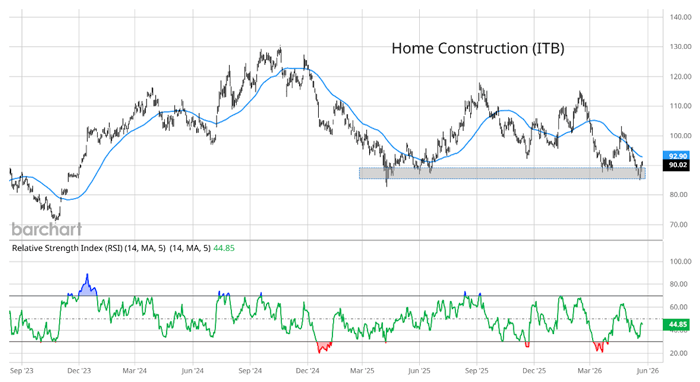
You can see that ITB has fallen to the lowest level seen since April 2025 and is 30% off the highs from late 2024.
The downtrend in housing stocks is nothing new, but the jump in rates is helping push ITB toward the lowest level in over a year. That stands in stark contrast to the S&P 500, which is hovering near record highs.
The impact of higher interest rates on housing stocks is a real cause for concern, but the downside move looks overdone.
At the same time, some of the largest stocks in the sector are testing key levels. That could set up a short-term mean reversion trade higher.
You might notice the ITB housing construction ETF is testing a key price support level. The same is true for some of the largest stocks in the sector.
Lowe’s (LOW) is one of the world’s largest home improvement retailers with over 1,700 locations across the U.S. The company’s stock hasn’t been spared from the sell-off in stocks across the housing industry.
But LOW is showing signs of a big reversal in the making. Take a look at the LOW chart below.
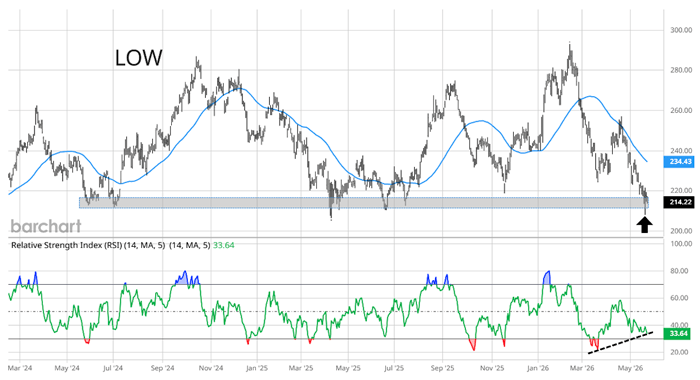
The first key signs of a reversal happened with a failed breakdown at the $210 support level. That support zone is shown with the shaded area. You can see that LOW made an intraday move below that level at the arrow following an earnings report last week… but then staged a large recovery higher.
At the same time that the $210 level was being tested, the Relative Strength Index (RSI) was making a positive divergence. As LOW made a new low relative to pullback into late March, the RSI made a higher low, as shown with the dashed line.
A failed breakdown below a key support level, coupled with a positive RSI divergence, is a strong sign of a reversal higher for LOW.
While it may seem like inflation and interest rates can only spiral out of control, the price action in housing stocks is pointing to a trend ready to reverse.
Happy Trading,
Larry Benedict
Editor, Trading With Larry Benedict
Reading Trading With Larry Benedict will allow you to take a look into the mind of one of the market’s greatest traders. You’ll be able to recognize and take advantage of trends in the market in no time.