Investors feel most comfortable in normal, orderly markets.
Stock movements are neat and predictable, so people have confidence that the outcomes they expect will happen without much upset.
The problem is that shocks come along when you least expect them. And they can have a disproportionate impact on your portfolio.
For example, an event might only have a 5% probability of occurring in normal circumstances. But during a market shock – like the sudden outbreak of war – those odds can go out the window.
Given the current shocks rippling through the market, today I want to go over some basic guidelines to decrease your chances of damaging losses…
A low-probability event is often referred to as “tail risk.” It refers to the outer ends (“tails”) of a probability distribution curve.
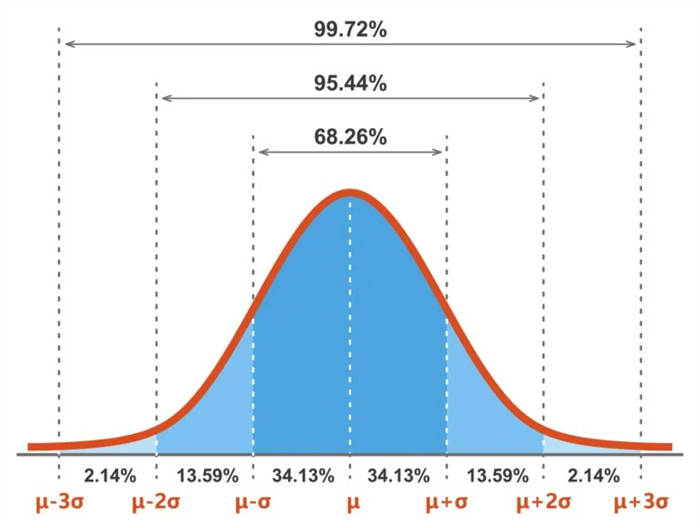
Source: Simply Psychology
If you take a typical curve, about 95% of the data occurs within two standard deviations. That increases to 99.7% if you go out to three standard deviations.
But even ultra-low 0.3% probability events can happen when uncertainty spikes… like now when we’re experiencing a war market.
The initial fighting occurred between Israel, the U.S., and Iran. But the range of the conflict quickly expanded as Iran retaliated against its Gulf neighbors. Even the Abu Dhabi and Dubai airports were hit. Very few would have predicted that Iran would lash out in such fashion.
To be clear, I’m not making any predictions. But shocks like this open the door for other “left field” events…
These hostilities raise the possibility of another superpower like China coming into the conflict. Or the war might expand into other regions… or cross over into banks and financial institutions.
Something that seems to have extremely remote odds in normal times can quickly change in highly uncertain times. The danger is in not adapting to the evolving conditions…
In times of war, the distribution of potential outcomes broadens. Take oil, for example. Just a week ago, a $100 oil price would have seemed like an impossibility anytime soon.
But if the Strait of Hormuz remains blocked and global shipping grinds to a halt, the odds of hitting that price increase dramatically – especially if major oil production facilities are destroyed. And stocks could fall further than expected if a risk-off wave sweeps through the market.
Traders have to be so careful…
In times like this, markets trade off the news headlines more than fundamentals – even if those headlines turn out to be fake. Plus, market reactions can be far bigger than you might imagine.
In times like this, I tend to reduce the size of my positions. If you don’t, you’re running a higher risk due to the bigger swings.
You’ve also got to think in terms of potential scenarios and not just the immediate price action.
For example, what else might happen if oil hits $110 or $120? Given oil’s impact on inflation, what will happen if inflation hits 4%? What could that mean for market sentiment, interest rates, and our positions? At these moments, even stocks with little correlation can be pulled down at the same time.
Options traders also need to ensure that they’re not on the wrong side of volatility. When tail risk explodes, selling options can get much riskier, and you don’t want to get caught off guard.
Additionally, in times of heightened uncertainty, liquidity can quickly dry up. Orders, including stop losses, could be filled at disadvantageous prices – if they’re filled at all. This can exacerbate losses.
Of course, wars and other calamitous events can subside as quickly as they arise. However, you can never take that for granted.
So until we get a clearer picture of this war’s outcomes, take a judicious approach…
Trade small and cut losers quickly. Stay on top of the market’s moves and make sure you’re comfortable with your level of risk. You might reevaluate your stop losses to make sure they’re sufficient to protect your account. This can also be a good time to store up dry powder so you’re ready when opportunities appear.
Ultimately, you want to be as prepared as you can be for worst-case scenarios. Because we may not have seen the last “low probability” event unexpectedly rip through the market…
Regards,
Larry Benedict
Editor, Trading With Larry Benedict
Reading Trading With Larry Benedict will allow you to take a look into the mind of one of the market’s greatest traders. You’ll be able to recognize and take advantage of trends in the market in no time.