Note: In May of 2022, our colleague Jeff Brown wrote about Rigetti Computing, one of his favorite quantum computing stocks. Over the past year or so, shares have jumped a mind-blowing 4,000%.
To put that in perspective, that’s almost 100 times better than NVIDIA. If you missed out on those massive gains, though, Jeff says you don’t need to worry.
Because tomorrow, October 21, at 8 p.m. ET, he’ll share an urgent online strategy session about his top three quantum computing stocks for “The Quantum Flashpoint.”
By the end of this month, the government agency that invented the internet, DARPA, is set to make a critical quantum computing announcement. And Jeff believes it will send his picks skyrocketing higher.
So if you’d like to hear more about the quantum opportunity Jeff sees coming, be sure to click here to automatically RSVP for his event.
The sums of money being tossed at artificial intelligence (AI) are becoming downright ridiculous. So far in 2025, OpenAI alone has announced computing deals that could top $1 trillion.
That includes a $100 billion deal with Nvidia (NVDA), a $300 billion cloud computing agreement with Oracle (ORCL), and an option to potentially buy a 10% stake in Advanced Micro Devices (AMD).
Even the U.S government is getting involved with a 10% stake in Intel (INTC).
It seems like each day brings another multibillion-dollar announcement between the familiar companies directly exposed to the AI buildout.
But while investors are fixated on stocks like Nvidia, a much bigger opportunity awaits.
It’s something that AI can’t live without… and has nothing to do with chips or cloud computing…
When you dig deeper into the details of the big AI deals, you will notice something interesting. Goals and milestones are frequently stated in terms of gigawatts of computing capacity deployed.
For instance, the agreement between Nvidia and OpenAI aims to deploy at least 10 gigawatts of AI data centers. That much power is comparable to the electricity consumption of New York City.
Targeting gigawatts is a nod to the massive electricity needs of new data centers being constructed to meet demand from AI applications.
Today, data centers account for 5% of total electricity demand in the U.S. That figure will more than double over the next five years.
That’s already putting a strain on the power supply. Consumer electricity prices are jumping to record levels as data centers gobble up energy. Electricity prices are rising twice as fast as the rate of inflation.
As a result, hype is growing around alternative sources of energy, like nuclear, to alleviate the strain on electricity demand.
But bringing on new nuclear capacity takes time due to large capital costs and red tape. One estimate pegs new nuclear energy meeting just 10% of additional data center electricity needs over the next decade.
That means the shortfall will need to be made up elsewhere. Luckily for the U.S., it has an abundance of another low-carbon energy source.
A report by McKinsey & Company estimates that the data center industry will need to invest $5.2 trillion by 2030 just to keep up with AI demand.
When combined with traditional data center uses, that figure swells to $7 trillion.
In order to meet demand for electricity from new data centers, the U.S. will need to take advantage of its massive natural gas reserves.
The nation is already the largest natural gas producer in the world. Annual production has soared by 105% over the past 20 years, thanks to advances in horizontal drilling and hydraulic fracturing. That’s allowed gas producers to tap into gas reservoirs trapped inside underground shale formations.
Natural gas is ideal for meeting data center demand because gas-powered generators can be ramped up or switched off quickly to meet changing demand needs.
Natural gas generators can also be “off-grid,” with gas-fired generators situated next to data centers without a connection to any public power grid.
Data centers could increase natural gas demand anywhere from 3 to 10 billion cubic feet per day by 2030. That would be as much as 28% more gas than what is currently used for electricity generation.
That’s why I expect great profit opportunities ahead for natural gas.
Just look at the United States Natural Gas Fund LP (UNG), which tracks natural gas prices:
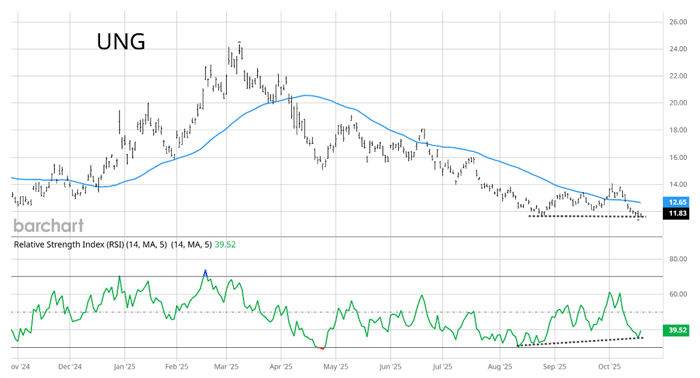
UNG could be setting up a reversal higher. That’s because UNG’s recent pullback is getting stretched below the 50-day moving average (blue line) just as the $11.75 support level is being tested (top dashed line).
At the same time, the Relative Strength Index (RSI) is making a higher low as UNG tests price support (lower dashed line). The RSI measures underlying price momentum and shows that recent downside pressure is fading.
Along with a major catalyst to drive natural gas demand, these are ripe chart conditions to see a reversal higher.
And while UNG is great for taking advantage of the broader natural gas opportunity, there’s one company that’s primed to benefit from the AI data center push.
I covered all this in more detail in a recent presentation that I’d encourage you to check out. So if you want to make sure you’re set up for the rising prospects in natural gas, be sure to tune in right here.
Happy Trading,
Larry Benedict
Editor, Trading With Larry Benedict
Reading Trading With Larry Benedict will allow you to take a look into the mind of one of the market’s greatest traders. You’ll be able to recognize and take advantage of trends in the market in no time.