All eyes are on the fallout from new Federal Reserve Chair Kevin Warsh’s first-ever speech at the Jackson Hole symposium.
In his debut speech, Warsh didn’t deliver much of a surprise for investors. He maintained a tough stance on getting inflation back to the Fed’s 2% target. He’s made similar comments in prior Fed meetings.
But Warsh also gave the impression that the Fed was in no hurry to act while noting that summer inflation data had improved.
However, investors who think the outlook for monetary policy won’t change much following Jackson Hole may face a surprise.
Many are growing complacent regarding the rate outlook. But commodities are already signaling inflation could take a turn for the worse…
Commodities are among the most sensitive assets to rising inflation. They historically deliver strong performance during periods of high inflation. They also show strong correlations to inflation expectations.
That’s because changes in commodity prices factor into production costs for goods and services – and thus the prices consumers pay.
And all across the commodity sector, inflation warnings are stacking up.
Take energy stocks, for instance. Energy is the best-performing sector in the S&P 500 this year. It’s up 37% year-to-date – far ahead of the 23% return from second-place technology.
A study from Hartford Funds shows that energy stocks are the best-performing sector during periods of rising inflation.
And then there’s copper, which is used in a wide variety of end markets. Copper prices on the London Metal Exchange (a good global benchmark) are up 68% in just the past year.
Agricultural commodities like wheat and soybeans are moving higher as well and are trading near their highest levels in years. That’s contributing to food inflation.
The movement across energy, metals, and agriculture is helping push a broad commodities basket toward another key breakout.
Prices are rallying all across the commodity sector and among producers.
Take a look at the weekly chart below of the iShares S&P GSCI Commodity-Indexed Trust ETF (GSG):
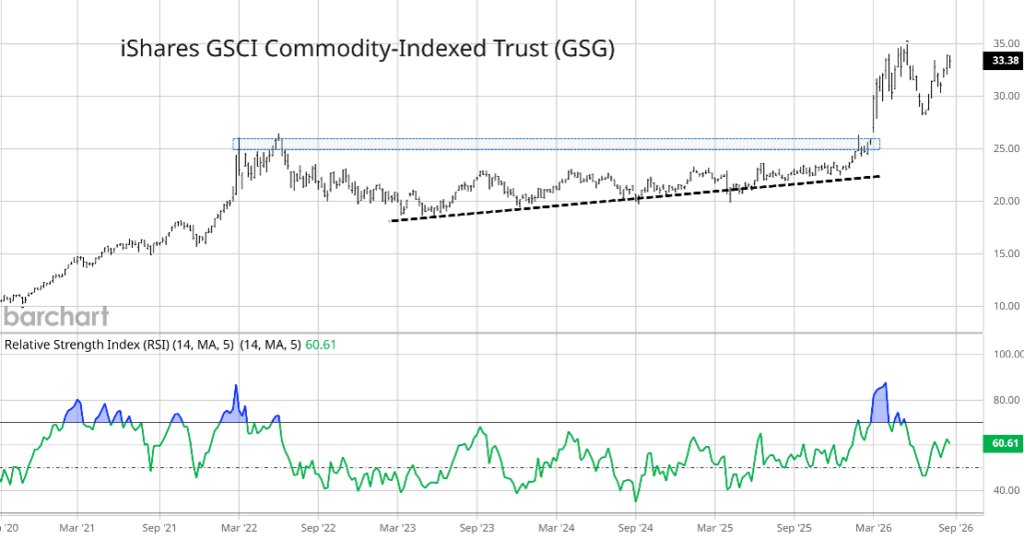
From 2022 through the start of 2026, GSG formed a massive chart base. Following the war with Iran and a spike in oil prices, GSG saw a major breakout.
The move higher in commodities, as tracked by GSG, helped drive the Consumer Price Index from 2.4% in February to 4.2% in May.
But now GSG is forming a bullish continuation pattern that could spark another move higher in consumer inflation. Take another look at the GSG chart over the past year:
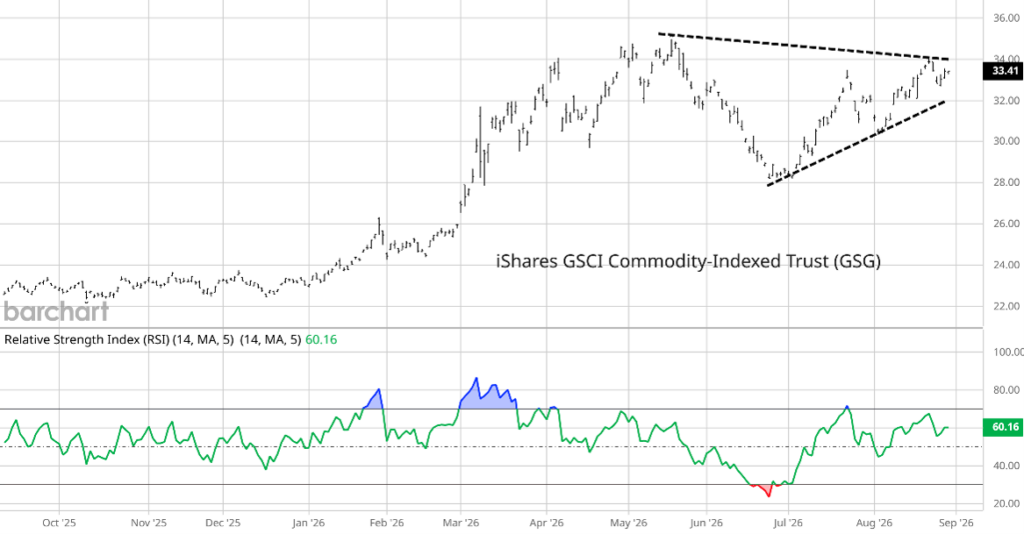
GSG is making a symmetrical triangle, shown with the dashed lines. Triangles usually act as continuation patterns. That means price tends to keep heading the same way it was moving before the triangle formed.
In this instance, you would expect a continuation move higher in GSG. That wouldn’t be a surprise given the broad commodities rally underway.
Commodity sectors from energy to metals and agriculture are sending a warning on the inflation outlook.
No matter what Warsh says at Jackson Hole, the Fed may have no choice but to hike rates in the months ahead.
Regards,
Larry Benedict
Editor, Trading With Larry Benedict
P.S. It’s worth paying attention to the moves in commodities for multiple reasons… including the fact that the vast sums of money being spent on AI are shifting into this asset class as the data center buildout picks up speed.
I covered the biggest opportunities I’m seeing during my AI Retirement Reset event last week. The replay won’t be up much longer, so if you want to get one of my top tickers for free, then be sure to watch here now.
Reading Trading With Larry Benedict will allow you to take a look into the mind of one of the market’s greatest traders. You’ll be able to recognize and take advantage of trends in the market in no time.