Larry’s Note: Sad but true… The vast majority of investors will miss Trump’s next “24-hour profit” window.
And believe me, Wall Street gatekeepers desperately want to KEEP it that way. Institutional players rake in billions of dollars by exploiting the emotional trading mistakes that everyday investors make.
Meanwhile, my “24-hour profit” strategy is turning the tables on Wall Street, handing anyone armed with my calendar of opportunities a chance to chance to pocket $597, $1,340, or even $2,010 in ONE day… regardless of what Wall Street is doing.
And on Thursday, November 6, at 8 p.m. ET, I’m explaining the strategy and sharing the ticker during an exclusive event. If you’d like to find out how this works, so you’re ready when Trump’s next 24-Hour Profit Window opens…
Go here to RSVP with a single click.
There was no shortage of headlines for the bulls this past week.
President Trump and Chinese President Xi agreed to a one-year trade war truce that reduces tariffs on Chinese imports and delays restrictions on rare earth materials.
At the same time, new deals and huge sums of money keep getting tossed around between artificial intelligence (AI) companies. At Nvidia’s recent GPU Technology Conference (GTC), we saw deals for AI supercomputers for the government and AI robotaxis for Uber.
That helped push Nvidia’s market valuation past $5 trillion, making it the first company to ever see that milestone.
And reports this week are suggesting that ChatGPT-parent OpenAI is clearing the way to go public as soon as next year… at a $1 trillion valuation.
But the good vibes are boosting only a select few stocks. Elsewhere, there is notable damage being done to the average stock.
It’s gotten so bad that one ominous indicator just triggered. And anyone with money in the market should take notice…
The foundation of a strong bull market is broad participation in the trend. That means there should be a large number of stocks rising when the market is rallying.
When a shrinking number of stocks are supporting the rally, that’s a warning signal that the bull market could be on borrowed time.
And the action underneath the stock market’s hood right now is a growing concern.
I showed you at the start of October how the number of stocks in short- and intermediate-uptrends was dropping.
It’s getting even worse.
While many investors are captivated by AI and trade war headlines that have kept the S&P 500 near record highs, there has been a surge in stocks making new 52-week lows.
The chart below shows the number of stocks making new 52-week lows on any given day this year:
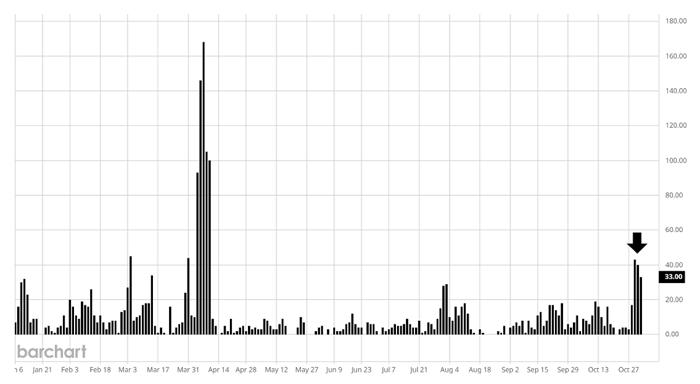
You can see the large spike in new lows during early April. That’s to be expected because the S&P 500 briefly touched bear market territory.
But look at the jump last week (arrow). That’s happening despite the S&P 500 reaching new highs last week amid the rally in stocks like Nvidia, Amazon, and Google-parent Alphabet.
We have a highly bifurcated market where new lows are expanding even as the S&P 500 holds near the all-time high.
It’s gotten so bad that a rare signal just triggered, which has historically been bad news for S&P 500 returns looking ahead.
Stock market breadth is important to monitor, which is why numerous indicators exist to measure participation in the trend.
That includes the Hindenburg Omen. The name leaves little to the imagination. It looks at various breadth statistics when the market is in an uptrend.
When you see a rising number of stocks making new highs and new lows at the same time, that plays a big part in triggering the indicator.
Now, to be fair, the Hindenburg Omen sometimes produces false warnings. A temporary dislocation will trigger the indicator while stocks keep marching higher.
But this signal has also triggered ahead of some of the most notorious market crashes, including 1987’s infamous Black Monday and 2008’s Great Financial Crisis.
Overall, a Hindenburg Omen is not good news for future returns. When it triggers, the S&P 500 has fallen by 6% on average over the next three months using data back to 2018.
So pay close attention to volatility going forward.
I’ve been pointing out the bubble risk in recent essays and on my podcast. The timing remains the final question.
But eventually, a handful of stocks won’t be enough to support the stock market’s advance.
Happy Trading,
Larry Benedict
Editor, Trading With Larry Benedict
Reading Trading With Larry Benedict will allow you to take a look into the mind of one of the market’s greatest traders. You’ll be able to recognize and take advantage of trends in the market in no time.