In currency markets, much of 2025 was dominated by “de-dollarization.”
Big global players, including foreign governments, sold down their U.S. holdings. That caused the value of the U.S. dollar (USD) to sink as they converted those U.S. dollars into other currencies.
However, as geopolitical risks began to develop at the start of 2026, that selling started to reverse. The USD regained its status as a safe-haven asset.
But like other markets, currencies can overshoot. After the USD’s sharp up move off its January lows, it grew overstretched, rising into overbought territory.
A promising pattern developed in the USD/JPY, so we decided to enter a trade that would benefit if the USD weakened against the Japanese yen.
So let’s see how things panned out…
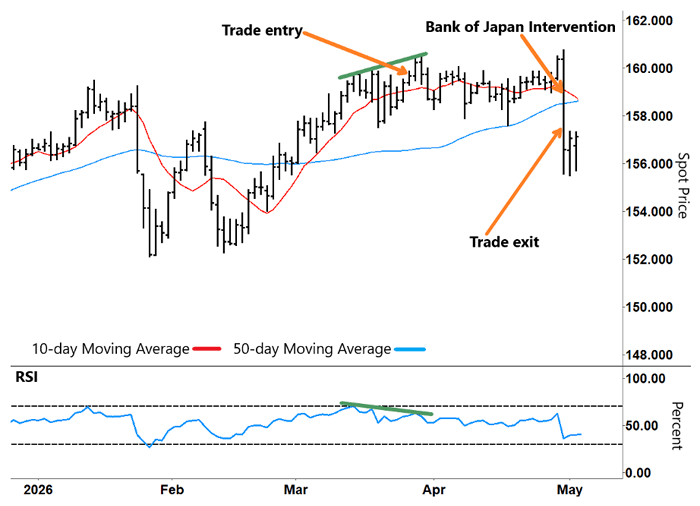
In the chart of USD/JPY below, you can see a diverging pattern (green lines).
The pair had been rallying (the USD was strengthening against the yen). But buying momentum was starting to weaken. That’s represented by the falling lower green line in the Relative Strength Index (RSI) at the bottom of the chart.
This kind of divergence often precedes a reversal.
USD/JPY Spot Price
Source: eSignal
Another key factor played a part in this trade…
Many anticipated that the Bank of Japan (BoJ) would intervene to support the yen if the price reached the 160 level. That has to do with the structure of Japan’s economy.
Japan needs to import the bulk of its energy (including coal, oil, and gas), which is typically priced in USD. It’s also a large importer of food, including staples like wheat, corn, and soybeans. A weaker yen makes all these more expensive to buy, which feeds into inflation.
So, with the pair overbought and tracking right around that key 160 level, we opened our short trade on March 26.
As you can see, the trade didn’t go our way right from the start. After trying to rally for a couple of days, the pair retraced and got stuck in a narrow 158–160 range. The upper level was capped by possible intervention from the BoJ.
The lower level was supported by the “carry trade.” Given that interest rates are higher in the U.S. than in Japan, investors will sell yen to buy U.S. dollars (USD) to take advantage of higher yields.
This tug of war played out for most of last month – it required us to remain patient. After continuing to pepper that upper level, the pair finally broke strongly above 160 on April 29. And that was enough to trigger the BoJ to intervene.
On April 30, the BoJ began to heavily sell USD (estimated at around $30 billion of selling) while simultaneously buying the yen. As stop losses were hit, other systematic funds and traders started to short sell the pair, adding to the wave of selling.
That saw the pair tank dramatically, which helped us hit our profit target. We exited the trade for a 200-pip profit. That equates to a $1,276 profit for anyone trading a standard lot position size.
The trade shows how my subscribers were able to generate a good profit in a challenging environment. It also reinforces the importance of a vital trading commodity… patience.
Happy Trading,
Larry Benedict
Editor, Trading With Larry Benedict
P.S. One of my readers wrote in: “I had another fantastic week with a gain of $45,992 from your trades. I have paid off most of my mortgage, gone on road trips with my girlfriend, and paid bills…” – Mark A.
Charles T. said: “I am up close to $40,000 in the past two months.”
Mark G. added: “In 7 days, my profit is $8,250. An unbelievable service, worth every penny.”
And William S. said: “I was able to pocket $16,950 in profits this week. Only 4 trading days.”
Last night, I shared the strategy that made these types of gains possible. Now the replay of my Zero Stock Retirement event is available for a short time. Watch here while it’s still online.
Reading Trading With Larry Benedict will allow you to take a look into the mind of one of the market’s greatest traders. You’ll be able to recognize and take advantage of trends in the market in no time.