Larry’s Note: Most traders dread market volatility. And I get it…
They’re perfectly happy to ride the S&P 500’s latest wave up. But as I discuss below, there’s good reason not to trust this rally.
Market volatility is going to return in a violent way. And when it does, the market will feel less like a holiday and more like traipsing through a minefield.
But for me and my readers, volatility can be an absolute gold mine.
Every spike in volatility… every panicked headline… every surprise move that sends the market lurching… those are setups for us. And here’s the twist…
We do it without buying, selling, or holding a single stock.
Instead, we have chances to pocket $149… $189… $250… $1,250… or even $2,500 from a single five-minute morning trade you can make while sipping your morning coffee.
I’ll share exactly what my strategy is… and how you can prepare for the coming volatility… tonight at 8 p.m. ET. There’s just a short window left to save your spot.
So don’t miss out. Add your name to the guest list with one click.
Investor complacency is running at levels I’ve rarely seen in my four-decade career despite many risks stacked against stock prices.
There’s the ongoing war in Iran, where the only certainty is confusion.
We don’t know what’s actually happening in the Middle East or who’s calling the shots in Iran. It’s unclear who really controls the Strait of Hormuz, where 20% of global daily oil consumption used to flow via tankers before the war.
It’s not just energy markets feeling the pain either. The Middle East exports nearly 49% of the urea that’s used in nitrogen-based farm fertilizers. That could have a big impact on the spring planting season currently underway.
The impact of the war is already showing up in inflation reports, with more price increases on the way. These higher inflation reports are rapidly changing the outlook for the economy and interest rates this year.
And these evolving conditions could come back to haunt investors…
The impact of the war with Iran is becoming more apparent in recent inflation reports.
The Personal Consumption Expenditures (PCE) price index – the Federal Reserve’s preferred inflation gauge – jumped by 3.5% in March compared to last year.
That’s the highest reading in nearly three years and continues an accelerating trend higher that you can see in the chart below.
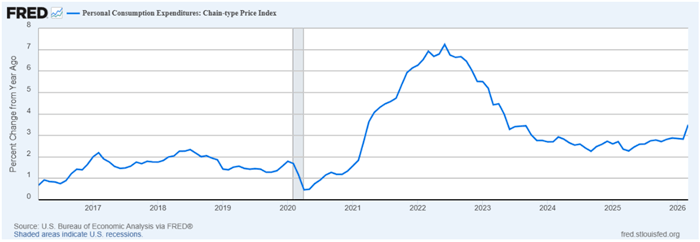
More price pressures are on the way. The ISM Manufacturing survey asks executives at manufacturing firms about business trends across the nation. One question pertains to the prices they’re paying for raw materials.
That number shot up to the highest level since May 2022 in the latest report. Back then, consumer inflation was running at 8.5%.
At the same time, there are concerning signs in the economic outlook. In the same manufacturing survey, the employment component dropped further into contracting territory.
A closely watched consumer confidence survey from the University of Michigan showed confidence plunging to the lowest level on record since the survey started… back in the 1940s.
Inflation pressures and growing concerns with the job market and consumer spending point to stagflation risks. Remember, stagflation refers to a pernicious combination of high inflation, stagnant economic growth, and elevated unemployment.
That has the Federal Reserve on high alert. A shift underway at the Fed shows the central bank is taking these risks seriously… which isn’t good news for investors.
As the outlook for the economy grows uncertain, the Fed isn’t going to swoop in and save investors.
The Fed’s hawkish pivot is gaining steam as inflation shows more signs of getting out of control. At the latest rate-setting meeting, the Fed elected to hold interest rates steady at a range of 3.50-3.75%. That move was widely expected.
But in an unusual surprise, there were four dissenting members.
The Fed usually projects unity on policy decisions to avoid roiling the market with uncertainty. The last time there were four dissenting votes was back in 1992.
The primary concern among dissenting members was the inclusion of language in the Fed’s post-meeting statement showing an easing bias in monetary policy. A growing number of Fed officials are becoming more concerned about inflation, which is dashing hopes for more rate cuts.
All this means that volatility is going to be on the rise in the stock market.
Higher rates tend to depress stocks, as it becomes more expensive for companies to borrow money and investors can find more attractive yields in “safer” assets like bonds.
The S&P 500’s quick trip back to record highs is fueling bullish sentiment. The Nasdaq alone has risen nearly 24% since March 30. That’s crazy.
And it won’t last forever. Reality is going to eventually set in.
When it does, be prepared for more choppiness as investors realize that bearish headwinds are stacking up…
Regards,
Larry Benedict
Editor, Trading With Larry Benedict
Reading Trading With Larry Benedict will allow you to take a look into the mind of one of the market’s greatest traders. You’ll be able to recognize and take advantage of trends in the market in no time.