Managing Editor’s Note: According to our colleague Jeff Brown, a radical new form of AI could handle everyday tasks for millions of people and send one California company soaring.
Hailed by Nvidia’s CEO as “the new computer,” this AI agent could book your appointments, fight your insurance-claim battles, and more.
A new AI superchip 50 times faster than Nvidia’s could dominate – Jeff’s sharing the full story, so get the full details here.
When a stock has been steadily falling, it’s natural to give it a wide berth. After all, why jump in and buy when sellers are firmly in control?
But some of the best trading opportunities emerge when a stock looks vulnerable. The key is spotting when selling starts to ease. Then you can position yourself for a rebound.
That’s what we did recently with banking giant JPMorgan Chase (JPM).
After watching JPM fall steadily from its August all-time high, we identified a potential rebound unfolding. By successfully capturing that move, my subscribers banked a 37.5% blended gain in just over a week.
So today, let’s see how that trade played out…

A new AI superchip 50 times faster than Nvidia's could reshape everyday life. Imagine an AI agent that books all your appointments, "clones" you at work, and more. Beginning on October 28, these changes could be driven by a new AI firm that could make you 1,000% on your investment if you buy now, BEFORE it goes mainstream. Get the full story here (including a free stock pick from an AI expert who recommended Nvidia before it rose 35,000%).
A drilling crew near the Grand Canyon just confirmed what the International Energy Agency calls enough energy to meet global electricity demand 140 times over. Google signed a 15-year deal, and Bill Gates wrote a $100 million check. On November 17, Washington hands this resource an edge no other energy source has. One company sits at the center. Get the name before November 17 >>
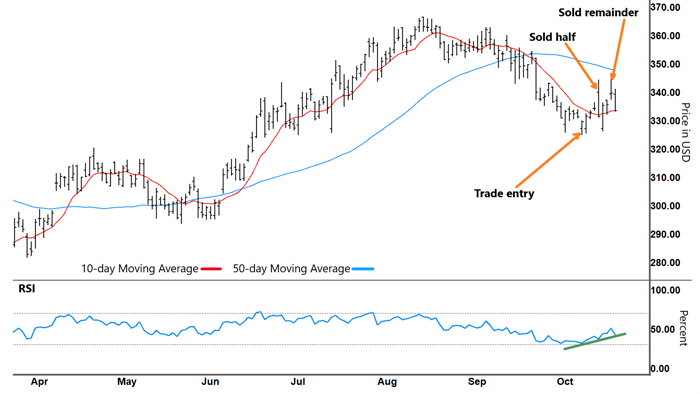
JPM had been on a decent run through the middle of the year. From its June low, JPM rallied 24% in just a couple of months. But that rally ran out of steam.
JPM rolled over and started making a series of lower highs and lower lows as selling pressure steadily built. By early October, it had fallen around 11% from its August peak.
That downtrend was confirmed with the 10-day moving average (MA, red line) crossing below the longer-term 50-day MA (blue line). At the same time, the Relative Strength Index (RSI) slid into the bottom half of its range. (The RSI is a momentum indicator.)
Check out the chart:
JPMorgan Chase (JPM)
Source: eSignal
When I see a stock fall like that, I don’t automatically assume it’s time to buy. You don’t want to catch a falling knife, as they say.
Instead, I look for signs that the selling pressure might be starting to exhaust itself. The RSI can help fill in part of that picture.
As JPM continued to fall, the RSI pushed toward oversold territory – marked by the lower gray dashed line in the bottom part of the chart. That suggested the down move was becoming overstretched and a rebound could be in the cards.
JPM was trading well below its 50-day MA, and the RSI showed selling was running out of steam. So on October 7, we bought a call option. If options are new to you, a call option typically increases in value when the underlying stock rises.
And the timing worked out nicely – our entry came right around the lows of JPM’s move…
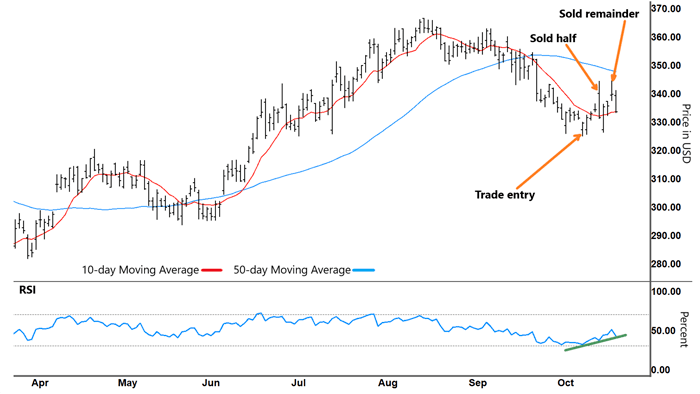
After we entered the trade, JPM began its recovery. Importantly, the RSI also turned higher, making a series of higher lows. That’s highlighted by the green line on the chart. It told us that buying momentum was returning.
Take another look:
JPMorgan Chase (JPM)
Source: eSignal
Soon after, JPM spiked on a volatile earnings day, pushing our call option into a healthy profit. So we took advantage of that strength to sell half our position for a 32.3% gain. That locked in some profit while giving the rest of the position room to run.
That’s how things played out. After briefly pulling back, JPM surged higher, enabling us to sell the remaining half for a 42.7% gain. That equates to a blended gain of 37.5%.
The important takeaway is that we weren’t trying to predict where JPM might trade a couple of months down the road. We weren’t expecting it to recover all of its lost ground since August either.
Instead, we identified a stock that had pulled back, waited for signs that selling pressure was easing, and positioned ourselves to capture a rebound.
To be clear, we used options to generate our return. Because options use leverage, they can magnify losses and gains. And because options expire, timing is especially important.
But as this JPM trade shows, you don’t need to capture a stock’s entire move to make good money. Sometimes all you need is a well-timed entry, a modest rebound, and the discipline to take your profits when you see them.
With those profits banked, we’re ready to move on to our next trade…
Happy Trading,
Larry Benedict
Editor, Trading With Larry Benedict
Reading Trading With Larry Benedict will allow you to take a look into the mind of one of the market’s greatest traders. You’ll be able to recognize and take advantage of trends in the market in no time.

