Larry’s Note: What if some of the most interesting trades in tech cost less than $1 per contract?
Jeff Brown and I call them Penny Tech Trades, and tomorrow, November 11, at 8 p.m. ET, we’ll trade our own money on camera to show you exactly how they work. One Nvidia trade went from 2 cents to $1 in two days while the stock was down.
Get all the details and reserve your seat with one click right here.
When a stock has been under sustained selling pressure, it’s easy to get caught up in all the negative sentiment and start to believe that it may never turn around.
But markets rarely move in a straight line. Even during a strong downtrend, there can be countertrend rallies along the way. And if you know what to look for, those rebounds can provide some great trading opportunities.
Just like we did with the iShares Silver Trust (SLV).
After a prolonged selloff, SLV had become oversold. Rather than assuming that the fall would continue indefinitely, we were looking for signs that selling pressure was abating.
That’s the idea behind a mean reversion trade. I look for a stock that has gotten overstretched in one direction. Then I aim to profit when it snaps back.
By buying a call option to capture a bounce, my subscribers picked up a blended 29% profit in under a week. SLV itself rose around 6.5% over the same period.
So today, let’s take a closer look at how the trade played out…

A Special Veterans Day Event: Wednesday, November 11, at 8 p.m. ET. For the first time ever, Silicon Valley insider Jeff Brown and hedge fund legend Larry Benedict are trading their own money on camera, using a brand-new kind of trade that costs less than $1. They call them “Penny Tech Trades.” And every attendee gets four of them free. The event is free, but availability is limited. RSVP "YES" with a single click here.

Nvidia is already worth trillions. For shares to double, it would need to add trillions more, which could take years. Meanwhile, hedge fund legend Larry Benedict says one trade on ONE ticker could hand you a chance at YEARS of gains in just days. And you could do it over and over again. All thanks to a series of pre-scheduled events in Washington, which could send billions of dollars surging into the market about every 11 days. Click here to get Larry’s three-letter ticker free before December 9.
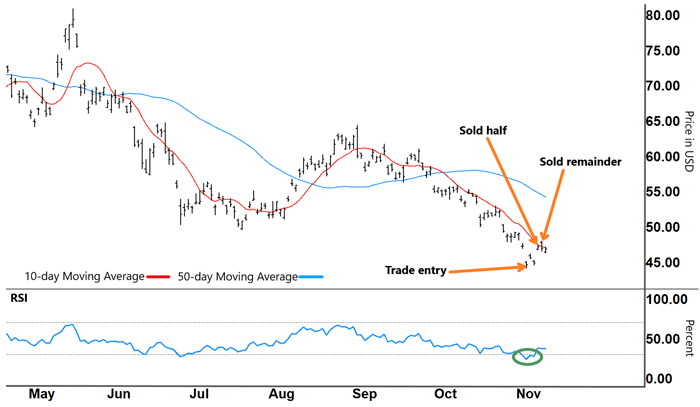
One of the indicators I use to help identify potential turning points is the Relative Strength Index (RSI). The RSI measures the speed and magnitude of recent price movements and can help us identify when a stock or ETF is overbought or oversold.
As SLV’s selloff picked up speed into late October, the RSI slipped into oversold territory (green circle). That’s below 30, shown by the lower gray dashed line. Check out the chart…
iShares Silver Trust (SLV)
Source: eSignal
That doesn’t automatically mean, however, that it’s going to rally. A market can remain oversold (or overbought) for some time before it eventually reverses direction.
But it does tell us the down move might be becoming overstretched. So on October 30, we bought a call option in anticipation of a potential bounce.
Importantly, we weren’t suggesting that SLV’s longer-term downtrend was over. Nor were we expecting it to rally back to its previous highs. Instead, we were simply looking for a bounce after an extended period of selling.
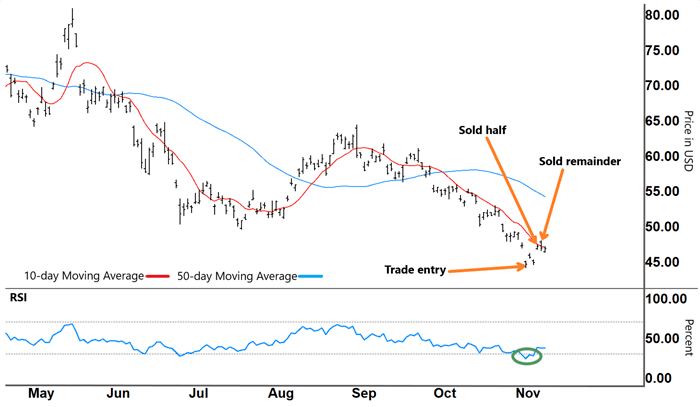
As the chart shows, things panned out as we anticipated. SLV began to recover from its lows, and momentum turned higher as selling pressure eased. That relatively modest 6.5% move in SLV translated into a much larger percentage gain in our call option.
With the trade quickly moving into profit, we decided to lock in some gains by closing half our position on November 4. That allowed us to bank a profit while keeping the remainder open to benefit from further upside.
On November 5, SLV was trading slightly above the previous close. So we closed the rest of our position rather than hold out for a bigger rally.
Take another look:
iShares Silver Trust (SLV)
Source: eSignal
Markets were swinging wildly that day amid the massive AI rout. In conditions like that, I don’t want to risk handing profits back. That way, the money is in the bank, and we’re ready for our next trading opportunity.
Now, to be clear, because options use leverage, they magnify both profits and losses. And because options have a finite life, timing matters. They can expire worthless if the anticipated move doesn’t happen in your expected time frame.
However, when the setup is right, they can enable us to generate sizable returns from a relatively modest move in the underlying stock – just like we did with this trade.
We didn’t need SLV to make an enormous move. We just needed to identify the right setup and be ready to take advantage when the opportunity arrived.
Happy Trading,
Larry Benedict
Editor, Trading With Larry Benedict
Reading Trading With Larry Benedict will allow you to take a look into the mind of one of the market’s greatest traders. You’ll be able to recognize and take advantage of trends in the market in no time.

