Managing Editor’s Note: Jeff Brown is stepping forward with his biggest discovery yet: a new “AI Superchip” 50 times faster than Nvidia’s. The company behind it could create a wave of new AI millionaires. Click here for the details and a recommendation to review by October 28.
The challenges keep coming for the AI trade.
Investors are second-guessing massive sums being plowed into AI – and whether the estimated $7.6 trillion in infrastructure spending through 2031 will be worth it.
AI debt costs are jumping, and the cost to insure against AI corporate defaults is rising quickly.
Enthusiasm for AI IPOs is also on the rocks, even resulting in one of the worst IPO performances in history this week.
Here’s why AI stocks are struggling for traction – and why the selloff in one AI sector looks overdone…
The man who urged the public to buy Nvidia at a split-adjusted 63 cents has a startling new prediction: "October 28 could spark a financial crisis." But he's not predicting a typical crash. Instead, he has a peculiar warning and a radical new recommendation to review immediately.

Larry Benedict ran a $900 million hedge fund for two decades without a single down year, a record that landed him in Hedge Fund Market Wizards next to Ray Dalio. The seven rules of discipline that got him there are now in one concise report. And today it is yours free: no cost, no credit card. Rules include the one trade you should never force, the personal situation that should pull you out of the market no matter what, and what it really means to earn your risk. Get all seven of Larry Benedict’s Trading Rules free.
AI headwinds keep emerging in recent weeks.
First, it was OpenAI’s revenue miss. The company reported an annualized run rate approaching $50 billion. That was about $20 billion below the roughly $70 billion figure reported in late September.
OpenAI blames the difference on an accounting discrepancy, but it scared investors into second-guessing the return on AI infrastructure spending.
Then came comments from the CEOs of Broadcom and Intel, who have a front-row seat to AI infrastructure spending. They sounded the alarm on another AI bottleneck: access to capital.
It’s not just high interest rates that are an issue. Investors are demanding extra compensation to lend to indebted AI companies. CoreWeave is a cloud computing company that rents out AI infrastructure like Nvidia GPUs. Some of the company’s bond yields jumped past 15%, signaling distress.
As mentioned above, investors are also revolting against new AI IPOs. In South Korea, an AI data center company called Elice registered the worst-ever opening day performance for a major South Korean IPO. The shares plunged by 32% on their debut.
The AI trade that was red hot just months ago seems to be suddenly going cold.
Despite the headwinds, though, there are emerging signs that the selloff is overdone. That could be setting up a mean-reversion trade in one beaten-up sector.
Memory stocks have been ground zero for the AI trade – on the upside and as they struggle for traction.
High-performance AI hardware requires vast amounts of next-generation memory, such as high-bandwidth memory (HBM). Companies operating in the sector include Micron Technology, SK Hynix, and Samsung.
There’s an ETF tracking the sector called the Roundhill Memory ETF (DRAM). The ETF is concentrated in the memory sector, with the three memory giants noted above comprising about 75% of the fund.
DRAM is a relatively new ETF and got off to a hot start. It gained 199% from its debut in April to the peak in late June. That top happened alongside many other semiconductor stocks, which gave way to a sharp reversal lower into late July. DRAM lost 44% of its value in that stretch.
After a recovery, DRAM has been pulling back since the start of October, following the latest challenges to the AI trade. But that could be setting up an oversold condition at a key level.
Take a look at the DRAM chart:
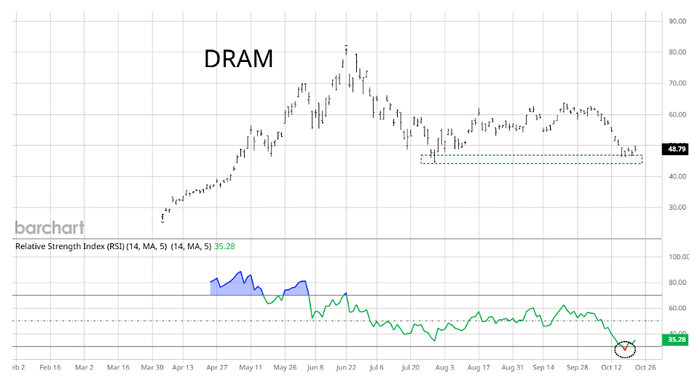
DRAM has fallen back to the same price support level that was tested in July, where price staged a rally. At the same time, the Relative Strength Index (RSI) – a momentum indicator – dropped into oversold territory below the 30 level.
A combination of oversold conditions with a test of price support could help spark another rally in DRAM. We’ll watch this ETF closely as sentiment around AI shifts, as it could provide a trade if this setup pays off.
Remember, stock prices don’t move in a straight line. Headwinds to the AI trade don’t mean the end of money-making opportunities. And this overdone move could prove profitable to traders who are paying attention…
Regards,
Larry Benedict
Editor, Trading With Larry Benedict
Reading Trading With Larry Benedict will allow you to take a look into the mind of one of the market’s greatest traders. You’ll be able to recognize and take advantage of trends in the market in no time.