I’m always looking for stocks that are trading at their extremes. That way, I can aim to profit when they snap back the other way. It’s a style of trading called “mean reversion” – and it’s been the cornerstone of my 40-year career.
When stocks get bid up too far, we watch for when they inevitably reverse. Similarly, when a stock gets sold off too far, we try to capture a rebound.
That’s what we did recently with one of the world’s largest exchange operators, Intercontinental Exchange (ICE). It owns and runs the New York Stock Exchange (NYSE) along with a broad range of other stock, futures, options, bonds, and commodity markets around the globe.
Like other exchange operators, ICE had fallen out of favor. Investors were worried that the rapid rise of prediction markets such as Kalshi and Polymarket could erode traditional exchanges’ business.
Yet those fears overlooked the fact that ICE had already taken a strategic stake in Polymarket. If prediction markets continue to grow, ICE stands to benefit.
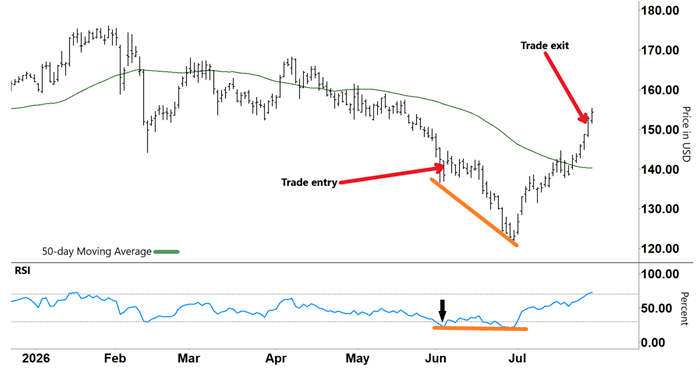
Those concerns pushed ICE down to its lowest level in almost two years. By early June, the stock was trading around 11% below its 50-day moving average – an overstretched move that belied the business’s strong fundamentals.
Despite getting the trade thesis right, we were a little early with the trade. Yet by being patient, we walked away with a 54.1% gain.
So let’s see how things panned out…
On the chart below, the 50-day moving average (MA, green line) shows ICE’s prevailing downtrend. That down move began in August 2025 after ICE peaked at its all-time high (around $189).
From its January peak to early June, ICE lost 22%. It had also pushed the Relative Strength Index (RSI), a momentum indicator, into oversold territory (black arrow).
Check out the chart…
Intercontinental Exchange (ICE)
Source: e-Signal
One of my favorite mean reversion signals occurs when the RSI forms a “V” out of oversold territory. That tells me selling momentum is beginning to exhaust itself and buyers are starting to regain control.
To capture that up move, we can use a call option. A call option typically increases in price when the underlying stock rallies. Options also mean our risk is clearly defined.
When you buy an option, the most you can lose is the premium you paid. In this case it was $2.73 (or $273) per option contract – one option contract is for 100 shares.
As you can see, after a promising start, the move in ICE soon stalled. Then, around the middle of June, ICE broke lower. It would have been frustrating if we had just bought shares instead.
By the time ICE bottomed out around the $122 level, we would have been down around $16 from where ICE was trading when we entered the trade. That equates to around $1,600 for 100 shares (the same number as one option contract).
Again, that’s why we use options – our risk is clearly defined ($273 in contrast). Plus, the call option gives us exposure to the upside.
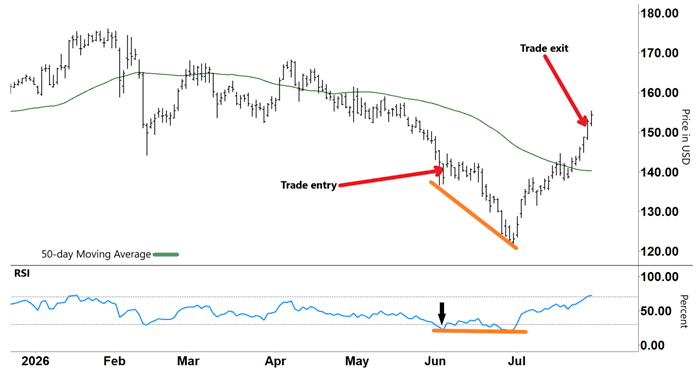
There was another reason we held on to the trade too. The RSI and the stock price were forming a converging pattern (orange lines). That’s often a bullish signal that selling pressure is abating. When the RSI rebounded again from oversold territory, this time sellers were exhausted. Rising buyer momentum saw ICE sharply reverse and begin to rally.
Again, check out the chart…
Intercontinental Exchange (ICE)
Source: e-Signal
After breaking through the 50-day MA – often a resistance level in a downtrend – ICE consolidated before bullishly breaking higher, pushing our trade into good profit.
The RSI pierced overbought territory (upper gray dashed line), putting ICE in danger of a reversal. We didn’t want to risk giving back those gains, so we exited the position on July 28 at $4.20, or $420 per contract – a tidy 54.1% gain.
Had we simply bought the shares, we would have likely been stopped out for a significant loss. Again, it highlights the versatility of using options. We can give a trade enough room to move while always knowing our maximum loss.
To be clear, because options use leverage, they magnify both profits and losses. And because options expire, timing matters.
However, when the setup is right, they allow us to strictly control risk while shooting for outsized gains – just like we did with this trade.
Happy Trading,
Larry Benedict
Editor, Trading With Larry Benedict
Reading Trading With Larry Benedict will allow you to take a look into the mind of one of the market’s greatest traders. You’ll be able to recognize and take advantage of trends in the market in no time.