If you’re new to options, one number can tell you how much your option should move when the stock does. It’s called delta.
For example, you might buy a call option in anticipation of a stock rallying. Delta tells you how much the call option should increase (or decrease) in value as the stock rises (or falls).
Delta is one of the “Greeks.” Traders use this metric to gauge an option’s sensitivity to changes in the underlying security.
And while this can seem like a complex topic, a basic understanding of delta can help make you a more successful options trader…
(If you enjoy this e-letter, I’d be very grateful if you recommended it to a friend. You can click here to forward it. Thank you!)
You’ll find an option’s delta quoted on most option trading platforms.
Deltas for call options are positive and range from 0.0 to 1.0. A call option should increase in value when the underlying stock rises.
For put options, deltas are negative and range from 0.0 to −1.0. A put option’s value should decrease in value if the underlying stock price goes higher.
But delta is especially useful in telling you how much that change should be.
For example, a call option with a delta of 0.5 means that the option should change by around half the stock price’s move.
That means there would be a $10 increase in your call option if the stock price rises by $20.
And if the share price dropped by $10, you’d expect the call option to fall by $5.
(Incidentally, a 0.5 delta is typically what you’d expect for an at-the-money [ATM] option. That is an option with a strike price that is the same or very close to the stock price.)
Let’s check out an example to see how it works…

After SpaceX placed a series of orders with one little-known supplier, its shares surged more than 1,000%. Now Larry Benedict believes Elon’s latest plan could ignite another overlooked company. See the ticker before the crowd catches on.

Elon Musk's new patent protects a new invention that could rewrite the future of wealth forever. It's a radical new form of AI Jeff Brown calls "M.A.G.I…" One so revolutionary that Elon called it an "infinite money glitch." Click here to see the details because he believes this is a once-in-a-generation opportunity to potentially create wealth on a scale most people can't even comprehend.
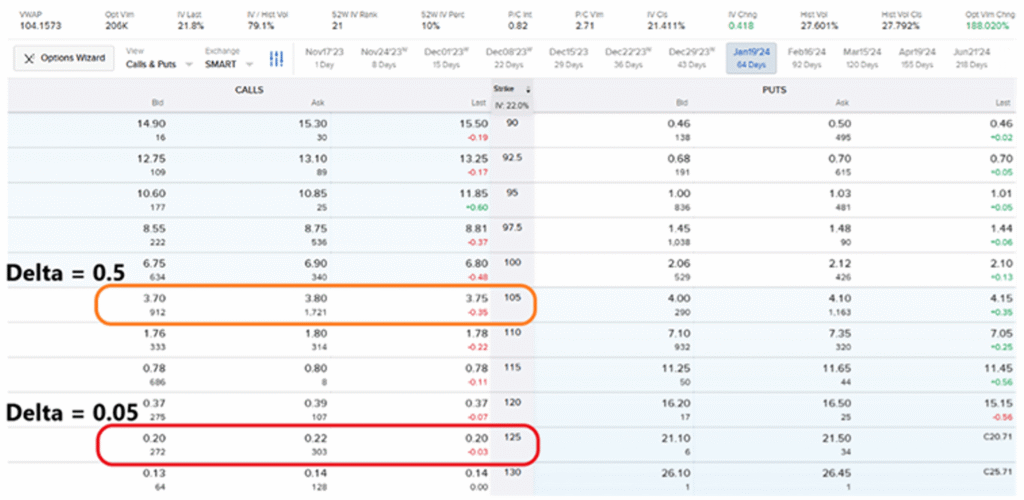
In the image below, you can see a range of call options (left) and put options (right) for Exxon Mobil (XOM). (Note that this is a historical example, not an active recommendation.)
The strike prices are down the middle. These options had roughly two months until expiry.
Exxon Mobil (XOM) Options
Source: Interactive Brokers
With XOM trading around $104 at the time, we could have bought an ATM call option (orange box) for around $3.80. That’s $380 per contract (100 shares per contract).
With a delta of roughly 0.5, this $105 call option should increase around $1 for a $2 rise in XOM’s price.
On the other hand, if XOM dropped by $2, the option would lose $1 in value.
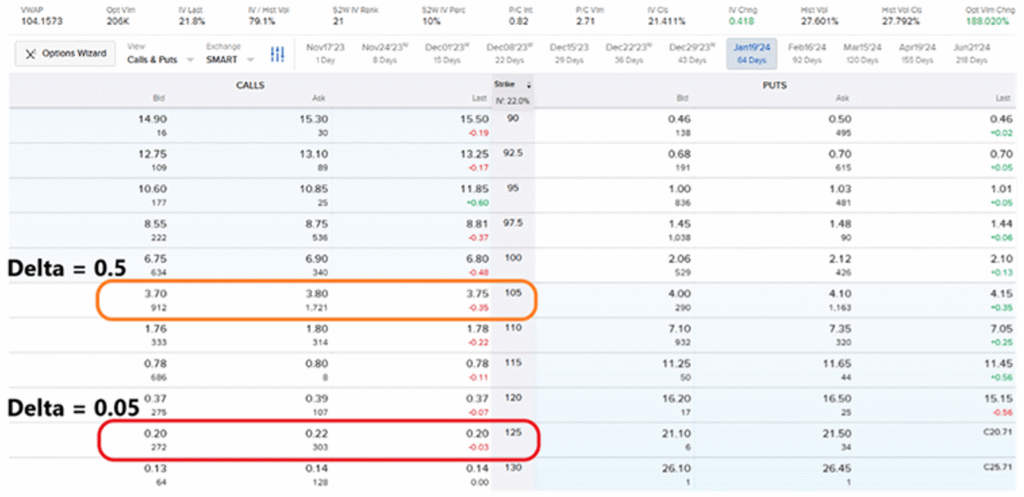
But compare an ATM $105 call option to an out-of-the-money (OTM) $125 call option (red box). (OTM refers to a call with a strike price well above the current stock price.)
We can see a big difference. Take another look:
Exxon Mobil (XOM) Options
Source: Interactive Brokers
The $125 call option would cost just 22 cents to buy – that’s $22 per contract.
But with a delta of just 0.05, even if XOM rallied significantly, it would have little impact on the call option’s value.
That’s only a five-cent increase in the call option during a $1 rise in the stock.
In this example, XOM would have to rally $20 to generate a $1 increase in the option’s value.
Compare that to a $2 stock move to generate a $1 gain on our ATM calls.
Ultimately, it’s a trade-off. Buying OTM calls is far cheaper than ATM calls.
Yet as our XOM example showed, you’ll need a much bigger move to be profitable.
If the OTM option is very far away from the stock price, even a big rally (or plunge) in the underlying stock won’t necessarily shift the value of the options by much.
So when you’re trying to pick an option, the trick is to find the right balance between what you pay for the option and its delta.
Get that balance right, and you’ll give yourself a much better shot at a winning trade
Regards,
Larry Benedict
Editor, Trading With Larry Benedict
Reading Trading With Larry Benedict will allow you to take a look into the mind of one of the market’s greatest traders. You’ll be able to recognize and take advantage of trends in the market in no time.

