The interest rate landscape is becoming more volatile across the yield curve.
On the short end, the Federal Reserve held rates steady at its meeting last week. That follows the first hike in over three years at the meeting in September.
In addition, longer-term yields are now pulling back from their highs.
The 30-year Treasury yield topped at 5.67% on October 7. The 10-year peaked at 5.31% just a couple of days earlier. Since then, the 30-year has fallen to 5.32% while the 10-year stands at 4.98%, as of Friday.
Rising rates and the prospect of overly hawkish monetary policy were big concerns for investors at the start of the month.
Now that the rate backdrop is turning the other way, it could help spark a reversal in the biggest market in the world.

A once forgotten American company is about to step into the heart of the race to build the next generation of AI. Larry Benedict believes November 30 could change how Wall Street sees it forever. See the ticker before it makes headlines.

Jeff Brown believes by the end of this month, this Elon Musk new AI breakthrough will collide… With a powerful market prophecy that has correctly predicted some of the biggest market booms going back to 1950… Giving Americans a rare and perhaps last chance to turn a small stake into an entire six-figure nest egg in the next 12-18 months. The last time something like this happened, investors had a chance to turn a small stake of $10,000 into as much as $366,000 in just 14 months.
The U.S. dollar is the most traded currency in the world, in a market that trades $9.6 trillion a day on average.
The U.S. Dollar Index (DXY) is a popular way to measure movements in the dollar against a basket of other major currencies. That includes the euro, British pound, and Japanese yen.
Interest rate shifts across different countries can impact currency pairs. Money flows to where it can earn the best return. So countries with higher interest rates tend to attract capital, and their currencies rise. Countries with low rates often see their currencies fall.
The outlook for monetary policy can play a role as well.
Back at the start of September, the rate backdrop supported a strengthening dollar. That’s when expectations grew for a Fed rate hike that same month, which the central bank delivered.
Long-term bond yields were also breaking out to the highest levels seen in decades back in September. Those interest rate movements helped spark a rally in DXY. Here’s the chart:
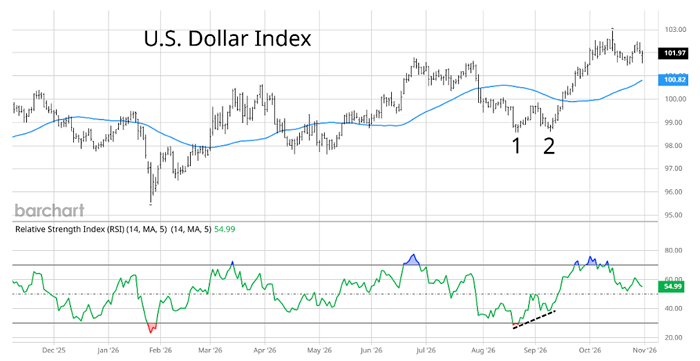
A pullback in late summer saw DXY make a double bottom at points “1” and “2.” A double bottom pattern often indicates a reversal of a downtrend, especially when paired with rising momentum.
The Relative Strength Index (RSI) measures underlying price momentum and made a higher low during the double bottom (dashed line). And as the pattern hinted, DXY rallied toward the 103 level as rates increased.
But now a bearish pattern is forming just as rates change direction…
The rally in DXY took the index to its highest level since April 2025.
But interest rates on the long end are pulling back. At the same time, the Fed sat still at its October meeting, moving forward without another hike.
As catalysts for a stronger dollar are removed, a bearish pattern is forming on DXY. Here’s the chart again:
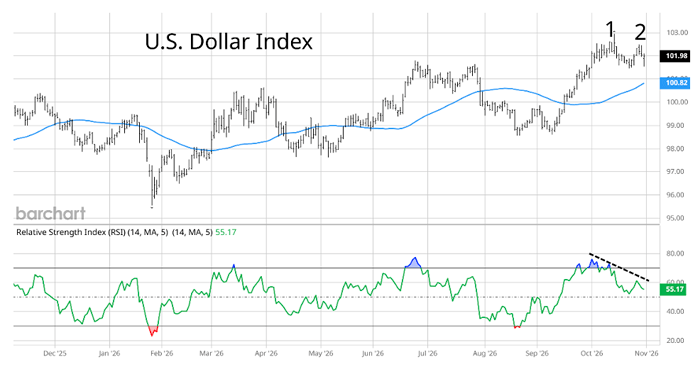
This time, DXY is making a double top at points “1” and “2.” The RSI fell during those points, showing weaker momentum.
If DXY takes out the October low around the 101.50 level, that would complete the double top pattern and point to more downside ahead.
As the situation around interest rates remains in flux, we’ll likely see plenty of trading opportunities for the dollar. That’s why it’s worth keeping DXY and major currency pairs like the dollar against the euro and yen up on your monitor as we head into the final months of the year…
Happy Trading,
Larry Benedict
Editor, Trading With Larry Benedict
Reading Trading With Larry Benedict will allow you to take a look into the mind of one of the market’s greatest traders. You’ll be able to recognize and take advantage of trends in the market in no time.