Managing Editor’s Note: Don’t forget to sign up for Jeff Brown’s AI Super Chip event today.
He’s about to share all the details of a radical new form of AI could handle everyday tasks for millions of people and send one California company soaring. It has to do with a chip that’s 50x more powerful than NVIDIA’s.
And you won’t want to miss the profits heading its way.
One of the things I particularly like about buying options is that we know our maximum loss before we enter a trade. That’s the premium we pay, plus any transaction costs.
That doesn’t mean you can afford to be complacent. But it does give us some flexibility when a trade doesn’t immediately go our way.
Just like a trade we did recently on the Financial Select Sector SPDR Fund (XLF).
We were a little early with our entry. But we were able to ride out a pullback that might have stopped us out if we’d bought the shares. And we ultimately closed the trade for a neat profit.
So today, let’s take a look at how the trade played out and why having clearly defined risk can be such an advantage…

The man who recommended Nvidia as far back as 2016 and Bitcoin in 2015 is stepping forward with his biggest discovery yet. A new “AI Superchip” 50 times faster than Nvidia's and the company behind it could create a wave of new AI millionaires. Click here for the details and a recommendation to review by today.

The federal government is set to trigger a limited time profit window on November 4. This profit window has opened every four years WITHOUT FAIL since 1950. You could potentially collect wins as big as $1,245… $950… and $1,325 nearly every single week. The last time it happened, “Market Wizard” Larry Benedict helped his readers make over $100,000 in just 12 months. If you’d like to know how… Watch Larry’s special presentation FOR FREE before this window closes.
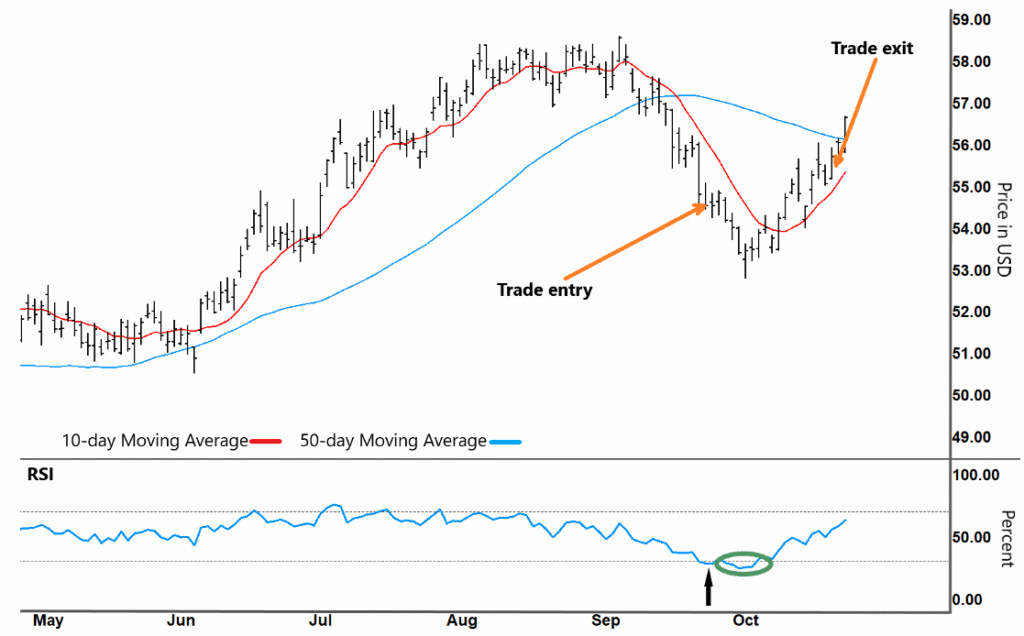
As you can see in the chart below, XLF enjoyed a strong rally through the middle of the year. From its June lows, it climbed steadily through July and August before topping out at just over $58 in September.
From there, XLF went through a sharp pullback.
That coincided with the Relative Strength Index (RSI), a momentum indicator, steadily tracking lower as buying momentum waned. As XLF continued falling, the 10-day moving average (MA, red line) crossed beneath the longer-term 50-day MA (blue line), with both subsequently tracking lower.
Check out the chart:
Financial Select Sector SPDR Fund (XLF)
Source: eSignal
The severity of that move put the RSI into oversold territory (black arrow). That’s what initially caught my attention.
My mean-reversion strategy looks for a stock or ETF that has become overstretched in either direction. The aim is to profit when it snaps back the other way. Sometimes, even a relatively small rebound can be enough to generate a healthy profit.
So we bought a call option on September 23. If options are new to you, a call option typically increases in value when the underlying stock rallies.
However, as the chart shows, right after we entered the trade, XLF made another leg lower. When you’re holding shares outright in a move like that, it can be difficult to stomach. You might decide to cut your losses rather than risk the stock falling even further…
With our option trade, we had an important advantage. We knew exactly how much we could lose before we entered the trade.
To be clear, this doesn’t mean you should sit on every losing position and hope for the best. However, knowing your maximum downside upfront gives you a different perspective on managing the trade.
Rather than worrying about how much more the stock might fall, you can focus on whether your original trade thesis still makes sense. In this case, we believed there was still an opportunity for XLF to recover.
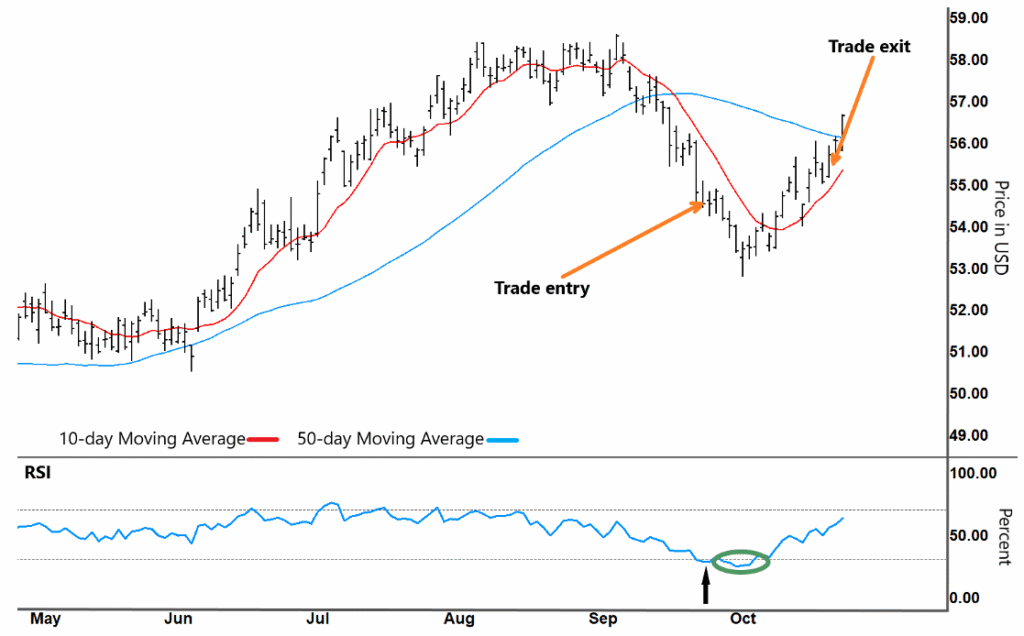
The RSI pushed deeper into oversold territory (green circle) before finally turning higher. That signaled selling pressure was easing and buying momentum was returning. XLF then rebounded as the RSI continued to track higher.
Take another look:
Financial Select Sector SPDR Fund (XLF)
Source: eSignal
That gave our call option the lift we were looking for. Rather than hold out for an even bigger move, we took advantage of the rebound. We closed the position on October 20 for a 15.9% gain – a solid return in less than a month.
We didn’t need to pick the exact bottom to make money. Our initial timing was slightly off, and the trade spent some time moving against us. But because we had clearly defined risk upfront, we had the flexibility to give the trade some room.
Of course, there’s no guarantee that a trade like this will recover. Sometimes the market can keep moving against you, and you can lose the entire premium you paid. That’s the trade-off.
But as this XLF trade demonstrates, being early doesn’t necessarily mean being wrong.
Sometimes the difference between a profit and a loss comes down to patience and the right trade structure.
Happy Trading,
Larry Benedict
Editor, Trading With Larry Benedict
Reading Trading With Larry Benedict will allow you to take a look into the mind of one of the market’s greatest traders. You’ll be able to recognize and take advantage of trends in the market in no time.