Managing Editor’s Note: Jeff Brown and Jason Bodner are holding an emergency briefing on Wednesday, May 20, at 8 p.m. ET called The 2026 Stock Market Regime Change.
Jason has built a proprietary indicator with a 100% accuracy track record going back years. And that’s important because he and Jeff believe we’re about to see a stock market “regime change” beginning June 8.
Jason doesn’t want you to be unprepared, so he plans to show how you could use his indicator to turn a few thousand dollars into a six-figure nest egg… possibly in less than a year.
During this briefing, you’ll have the chance to learn about:
It’s free to attend, and you can register instantly here with a single click.
Investor euphoria over the AI trade is colliding with a harsh reality.
AI hyperscalers, chip stocks, and other companies leveraged to the AI boom have been seeing their share prices soar. Since the end of March, Micron (MU) shares are up 146%. Intel (INTC) has soared by 194%.
Mega-cap AI stocks are also dominating the S&P 500 once again. About half of the S&P’s gain since April can be attributed to just five stocks in the index, including names like Google-parent Alphabet (GOOG) and Nvidia (NVDA).
But this complacency is hitting the markets at a time when a key rally ingredient is fading… and may completely reverse.
Here’s a big warning sign telling investors to watch out…
Short-term interest rates peaked at 5.5% in 2024. Since then, the Fed has cut rates by 1.75%, which has helped boost the stock market.
Lower rates make it easier for companies to borrow money for expansion and development. That tends to help stock prices, especially in growth and technology.
Investors were hoping for more, as President Trump has demanded lower rates. With his pick for the new Fed chair about to take the reins, many initially assumed that lower rates were nearly a given.
But now, growing inflation pressures are clouding the outlook for monetary policy.
While the war with Iran and its impact on energy markets have grabbed recent headlines, price pressures have been building since last year’s trade war.
Likewise, the disinflation trend has stalled out. (Remember, disinflation means inflation is rising at a slower pace.) Take a look at the Consumer Price Index (CPI) chart below.
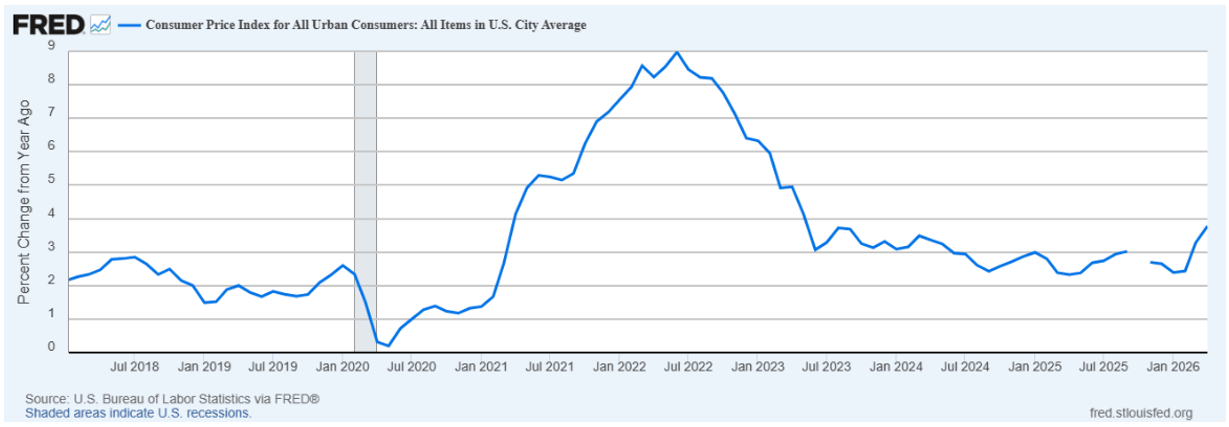
The CPI hit a peak of 9% in mid-2022 following the impact of the COVID pandemic on supply chains, stimulus spending, and a spike in oil prices following Russia’s invasion of Ukraine.
Since then, disinflation took hold. But you can see that the rate of inflation stopped slowing in early 2025.
Now a similar set of circumstances is pressuring inflation once again. Supply chains are in upheaval following last year’s trade war. We’re seeing large federal budget deficits from stimulus spending. And we have a war in another key energy-producing region in the world.
The April CPI report released this week jumped to 3.8% compared to last year and is the highest level in three years.
It’s even worse with producer inflation, where the Producer Price Index (PPI) soared to 6.0% in April… the biggest increase since the end of 2022.
Growing problems on the inflation front pose a risk to interest rates. That’s a problem for stock prices and the AI trade doing the heavy lifting.
Following the latest round of inflation data, the outlook for interest rates is evolving.
Earlier in the year, when the labor market was stalling out and inflation wasn’t jumping, investors were hopeful for more rate cuts this year.
But even before this week’s CPI and PPI data, there was growing dissent among the Fed committee that sets interest rates. A shift is underway, and inflation is viewed as a larger threat.
Not only have odds for a rate cut completely gone away, but the market is now entertaining the idea of a rate hike later next year.
The last time jumping inflation caused the Fed to raise interest rates, we ended up with 2022’s bear market. The S&P 500 fell as much as 25%, while the Nasdaq dropped by 36%.
Valuations and stock market concentration in just a handful of AI names are back to extremes once again.
But as the punchbowl of easy monetary policy goes away, the party is going to end.
This is a clear warning, and investors should think twice before chasing stocks at record highs…
Regards,
Larry Benedict
Editor, Trading With Larry Benedict
Reading Trading With Larry Benedict will allow you to take a look into the mind of one of the market’s greatest traders. You’ll be able to recognize and take advantage of trends in the market in no time.