Larry’s Note: Last Thursday, I showed how to pocket gains in a single day – and do it over and over again…
I’ve used this strategy to hand my readers multiple chances to pocket $149… $189… $250… $1,250… or even $2,500 or more in a single trade. And because each trade closes at 4 p.m. ET that same day, we don’t have to worry about what headlines will break overnight.
This is the same strategy I used at my hedge fund to great effect… It enabled me to go 20 years without a losing year.
The replay of my Zero Stock Retirement event will only be available for a short time longer. So if you haven’t yet, watch the replay here now.
Investors were greeted with good news on the Middle East war last week.
The U.S. and Iran may be getting closer on a peace deal that would include reopening the Strait of Hormuz.
Before the war started, the Strait saw around 20 million barrels of oil products pass through every day. Since the start of the war, it’s estimated that over 500 million barrels of production have been lost.
That’s certainly showing up in oil prices, which spiked to their highest level in four years. That is having a spillover effect on numerous energy markets.
The national average for a gallon of gas in the U.S. hit $4.55. Airlines are buckling under the strain of higher jet fuel costs, with prices doubling since the start of the war.
With hopes of an agreement to reopen the Strait, oil prices saw a sharp drop. But investors shouldn’t expect the pullback in oil prices to last or reach levels seen before the war.
Here’s why oil’s downside could be limited from here…
Before the outbreak of war in the Middle East, oil prices were grinding steadily lower over a multiyear stretch.
The chart below plots the price for a barrel of oil back to late 2023.
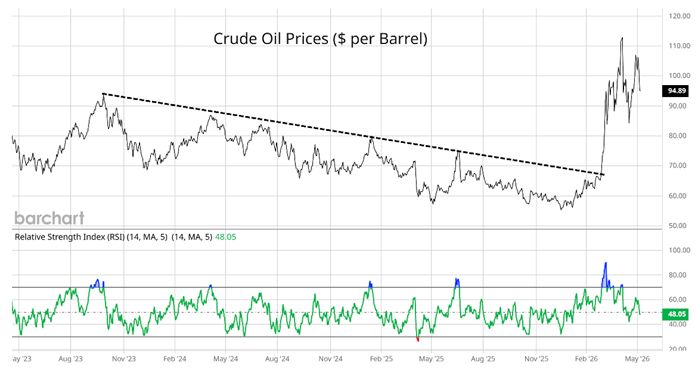
Oil was locked in a downtrend with a series of lower highs (dashed line) and lower lows in price along the way.
Oil found a bottom around the $58 level a year ago, shortly before a limited round of strikes against Iranian nuclear sites.
Oil retested those lows in December – then received a jolt following a surprise U.S. military operation to capture Venezuela’s president.
That jolt should’ve provided a hint that the geopolitical risk premium being priced into oil was too low. The war with Iran and the subsequent closure of the Strait of Hormuz sent oil spiking to nearly $120 on an intraday basis.
That’s the highest level since 2022, when Russia surprised the world by invading Ukraine.
Now oil is pulling back from the recent highs. But simply reopening the Strait won’t result in a meaningful drop in oil… even if a deal is reached.
Oil’s price action has settled into a range since the war with Iran broke out. Take another look at the chart.
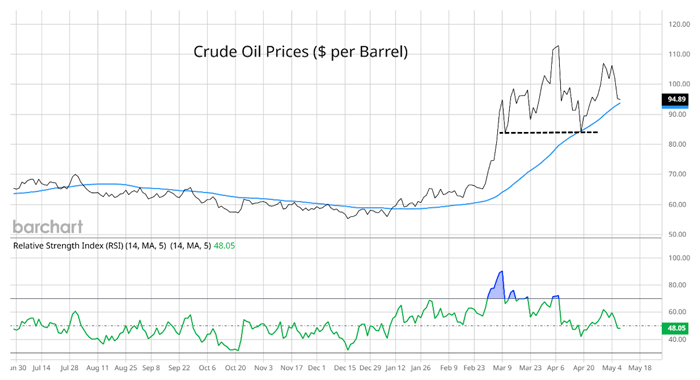
After spiking higher upon the start of the war, oil has tested support at the $84 level on two occasions since then. The second test also coincided with hitting the 50-day moving average (blue line).
Support at the $84 level looks like an area for traders to position for a bounce. We can expect upward pressure on oil prices to persist for the foreseeable future.
Whether it’s the war against Iran or a military strike inside Venezuela, President Trump has shown that he is not shy about taking actions that rattle energy markets.
The precedent has now been set for the Strait of Hormuz to be an energy chokepoint as well.
At the same time, the recent exit of the United Arab Emirates (UAE) from OPEC has shaken the organization. The UAE was OPEC’s fourth-largest producer.
The uncertainty in the energy markets means that the geopolitical risk premium should shift higher and limit any downside in oil prices.
The war in the Middle East should have another lingering impact as well. Bringing oil production back online can take time, as the war targeted energy infrastructure across numerous countries.
One estimate by the International Energy Agency forecasts that it will take two years for a full recovery of oil output due to repairs needed to damaged fields and infrastructure like pipelines… and that assumes no other flare-ups in the conflict.
For investors hoping for a quick resolution to high oil prices, prepare to be disappointed. As traders, though, we’ll keep this sector on our radar, as continued volatility in energy should hand us opportunities for short-term profits…
Regards,
Larry Benedict
Editor, Trading With Larry Benedict
Reading Trading With Larry Benedict will allow you to take a look into the mind of one of the market’s greatest traders. You’ll be able to recognize and take advantage of trends in the market in no time.